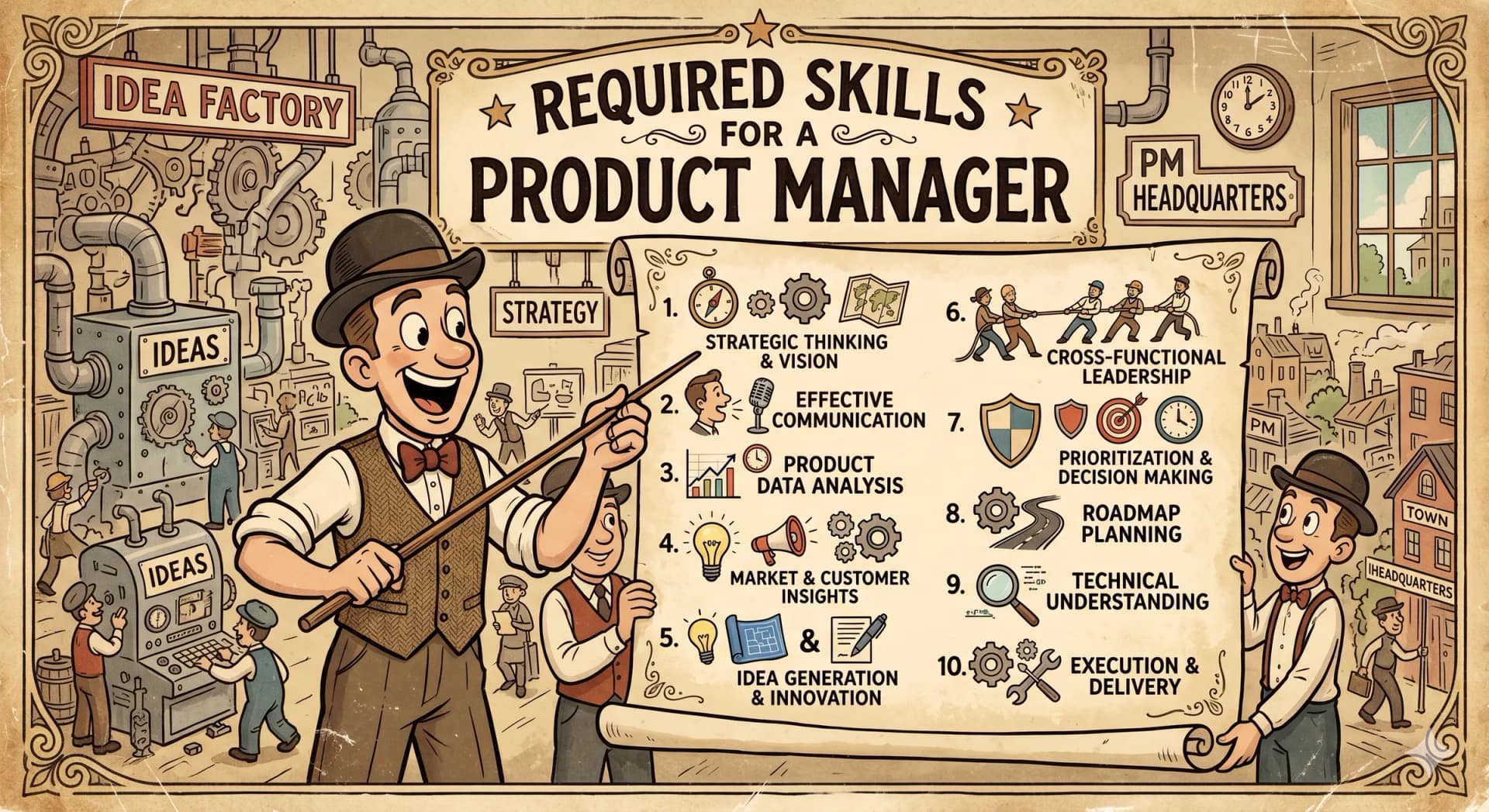
Core Skills to Be an Effective PM in 2026
24 skills across 5 domains, sourced from product leaders at Stripe, Linear, Amazon, Uber, and Revolut. Each skill includes what it is, what it isn't, and how to build it.
Skill Domains
Customer Insight & Discovery
4 skills
Strategy & Decision-Making
4 skills
Shaping & Craft
5 skills
Communication & Influence
5 skills
Execution & Ownership
6 skills
Customer Insight & Discovery
Product-market fit starts with proximity to the customer. These skills move PMs from arm's-length analysis to genuine emotional understanding — feeling the problem, not just documenting it.
| Skill | What It Is | What It Isn't | How to Build It |
|---|---|---|---|
| Customer EmpathyWeinstein · Systrom · Kao · Yu | Deeply feeling the emotional pain points of customers through immersion and observation — not just cataloguing surface-level feedback. | Pitching to the customer, guessing needs based on internal assumptions, or analysis that misses emotional valence. | Run 'Study Groups' where you act as if you don't work at the company. Dogfood your product in real-world conditions. Ask questions until you feel the customer's frustration firsthand. |
| Active ListeningDoshi | Reaching a level of understanding that enables genuine leadership — going well beyond surface-level recaps of what was said. | Performative listening, waiting to talk, or repeating back what was said without synthesising the meaning. | Study deep listening resources. Resist filling silence. Let the customer complete their thought before forming any internal response. |
| Working BackwardsMcAllister | Starting with a deeply defined customer problem before deciding on any technical solution — the outcome drives the design. | Solution-first thinking or retrofitting problems onto pre-existing technical ideas. | Write an internal press release: problem paragraph, solution paragraph, customer quotes. Create an FAQ that forces you to articulate every assumption. |
| Product TasteDoshi | The ability to identify high-quality ideas before seeing results — evaluating the quality of the input, not just the output. | Results-oriented evaluation or grading ideas solely by social proof and authority signals. | Shed authority bias. Learn to recognise game in the practice session rather than waiting for the final score. |
Strategy & Decision-Making
Strategy is not a slide deck — it is a cohesive plan that replaces the need for complex planning rituals. These skills cover setting direction, choosing the right metrics, and using data to validate bets rather than gut feel.
| Skill | What It Is | What It Isn't | How to Build It |
|---|---|---|---|
| Product StrategyDoshi | A cohesive, real plan that creates organisational alignment and eliminates the need for overlapping planning rituals. | Execution-only thinking or tactical work without a guiding vision. | Evaluate ideas separately from authority bias. A real strategy should replace — not complement — complex planning cycles. |
| Thinking BigMcAllister | Hunting for the largest possible impact and expanding narrow scopes into transformative business visions. | Operating strictly within a pre-defined box or accepting incremental by default. | At the start of every project ask: 'Could this be bigger?' Identify and actively knock down the external barriers limiting the idea. |
| Metric SelectionWeinstein | Identifying numerical representations of customer value that force meaningful trade-offs and align the team around what matters. | Internal-facing metrics, vanity KPIs, or counting technical logs without a customer perspective. | Identify what causes a user a 'bad day' and track it. Find cohort metrics that improve speed or success rate rather than just volume. |
| Experimentation DisciplineKamat | Using data and scientific testing to validate hypotheses and democratise performance measurement across the team. | Packaging intuition as data, or letting the loudest voice in the room win prioritisation debates. | Move from hypothesis to data as fast as possible. Measure through cohorts to filter out macro noise. |
Shaping & Craft
Shaping is the bridge between abstract strategy and concrete execution. These skills cover narrowing problems to the right level of abstraction, obsessing over details that matter, and finding creative solutions an incremental mindset would miss.
| Skill | What It Is | What It Isn't | How to Build It |
|---|---|---|---|
| ShapingSinger | Narrowing down a problem and sketching a solution with just enough detail for engineering to understand the full scope without being overspecified. | Breaking work into 100 disconnected tickets without a cohesive whole — the 'paper shredder' approach. | Hold live sessions with a designer and senior engineer. Use breadboarding and fat-marker sketching to maintain high-level but concrete focus. |
| Product CraftWeinstein · Systrom · Buchheit | Obsessing over the details of an experience while having the wisdom to prioritise what truly matters for the core value proposition. | Treating delight (the dessert) as more important than the fundamental value (the meal). | Fix the burning problem before adding beauty. Identify three key attributes, get them right, and direct 80% of effort there. |
| SimplifyingWeinstein · Systrom · Dhiman · Singer · Crowley | The ability to break complex projects into the most important tasks and remove friction or cognitive load that doesn't serve the user. | Perfectionism without business perspective, or overspecifying into many small tickets without a unifying vision. | Read your writing aloud to spot complexity. Get reps by shipping frequently. Ask peers to shred your work for clarity. |
| Radical CreativityYu | Thinking outside existing constraints to explore the full possibility space of a solution — not just the obvious middle ground. | Thinking within defaults or accepting incremental improvements as the ceiling. | Ask: 'What is the most extreme version of this?' Build that version quickly to learn where the actual ideal lies. |
| Detail OrientationRevolut PM Team | The ability to zoom into technical or regulatory details at the lowest level, then zoom back out to a strategic view without losing context. | Staying strictly high-level or acting as a 'status catcher' who doesn't understand the underlying work. | Shadow engineers at a code level. Formalise successful one-off projects into scalable, repeatable processes. |
Communication & Influence
Communication is not a soft skill — it is a precision tool. These skills cover explaining clearly enough to change outcomes, managing up to reduce leadership's cognitive load, and building the trust that compounds into real influence.
| Skill | What It Is | What It Isn't | How to Build It |
|---|---|---|---|
| Effective CommunicationKao | Explaining things clearly, compellingly, and accurately in a way that increases the likelihood of achieving the desired outcome. | The illusion that communication has taken place — where words were exchanged but understanding was not created. | Practice 'Sales then Logistics' framing. Reflect on your own contribution to every misunderstanding rather than attributing it to the other party. |
| ConcisenessKao | Economy of words with high density of insight — saying more with less, without sacrificing necessary information. | Long-windedness, meandering preambles, or brevity that omits what the reader needs. | Know your core point before you start writing. Reread every message and trim at least 20% of the content before sending. |
| SignpostingKao | Using specific words and structures to guide a reader through the logical flow of information without requiring them to infer the structure. | Unstructured output where the reader must decode what order things matter in. | Use anchor phrases: 'for example', 'because', 'as a next step', 'first, second, third.' These do the structural work so your ideas don't have to. |
| Managing UpSystrom · Kao | Operating proactively to give leadership visibility and alignment — reducing their cognitive load and the need for direction. | Waiting for well-defined tasks to be delivered, or asking what to do rather than sharing your recommended path. | Commit to this mantra: say you'll do the thing, do the thing, say you did the thing. Never ask upward without a recommendation attached. |
| Earning TrustMcAllister | Building professional currency by consistently meeting expectations through transparency, honesty, and accountability over time. | Being evasive, over-promising, or externalising blame when something goes wrong. | Tell the truth without exception. Own errors immediately and publicly. Build cross-functional alliances before you need them. |
Execution & Ownership
The PM is the emotional centre of the squad. Execution is not about managing tickets — it is about taking ownership of outcomes, moving fast without sacrificing quality, and doing the unglamorous work nobody else will do.
| Skill | What It Is | What It Isn't | How to Build It |
|---|---|---|---|
| High AgencyKao · Doshi · Dhiman | Finding ways to achieve goals and execute creatively without waiting for perfect conditions, resources, or instructions. | Reactive posture, waiting to be told what to do, or attributing failures to circumstance and environment. | Take strong ownership of problems. Adapt your approach to different team cultures. Combine agency with self-awareness to avoid being abrasive. |
| Speed & QualityYu | Producing high-quality, workable output at rapid pace by deeply mastering your craft — not by cutting corners. | The false trade-off where slowness is equated with quality, or rushing that produces rework. | Aim for a workable solution within the first 10% of the time budget, then iterate and refine from there. |
| Growth MindsetSystrom | The meta-skill of being self-reflective, open to painful feedback, and viewing failures as the primary source of learning. | A defensive mindset or settling for your current skill level as the ceiling. | Practice radical vulnerability by sharing and reflecting on your most painful mistakes. Focus on getting 1% better every day. |
| Raw Problem SolvingRevolut PM Team | High cognitive ability to navigate ambiguity and learn new domains rapidly without relying on prior experience as a crutch. | Relying solely on credentials or past patterns to justify decisions in new contexts. | Benchmark yourself against industry leaders outside your company. Seek out high-intensity projects where you have no prior expertise. |
| Carrying the WaterCrowley | Willingness to perform the unglamorous tasks — QA, support, copy — required to make a product actually successful. | Saying 'that's not my job' when the gap between what needs doing and what's assigned is visible. | Develop an ownership mindset where you fill every gap needed to deliver the business result, regardless of title. |
| Following Up on ResultsCrowley | Monitoring and sharing the actual impact of a feature weeks or months after launch — closing the feedback loop. | Ship-and-forget mentality where the only data shared is from launch week excitement. | Set calendar reminders for two weeks, one month, and six months post-launch to check dashboards and share outcomes with stakeholders. |
AI Product Manager Skills
AI PMs need the same core domains as traditional PMs, plus capabilities specific to AI-native products. Each maps back to foundational skills in the taxonomy above.
| AI Skill | Maps To | What It Means for PMs |
|---|---|---|
| AI Knowledge & Technical Fluency | Detail Orientation · Product Strategy | Enough understanding of models, training data, and inference to motivate ML engineers and hold informed architecture conversations. This is not about writing code — it is about knowing when the pipes have a problem. |
| AI UX & Explainability | Shaping · Product Craft | Designing interfaces that help users understand what data feeds the AI, when it can hallucinate, and why they should trust it. The AI PM owns the explainability gap between model output and user confidence. |
| AI Strategic Thinking (Build vs Buy) | Product Strategy · Thinking Big | Knowing when to build in-house, when to wait for a foundation model provider to ship the capability, and how pricing scales if the product succeeds. Requires triple-strategy thinking: product + data + AI. |
| Eval Design & Quality Measurement | Metric Selection · Experimentation Discipline | Writing evals — systematic quality measurements — is considered the number one skill for PMs in the AI era. Evals replace vibe checks with codified, binary pass/fail criteria and are the real moat for AI products. |
| Responsible AI & Guardrails | Metric Selection · Customer Empathy | Bias detection, hallucination mitigation, and safety constraints. Watching for perverse incentives in AI systems the same way traditional PMs watch for metric gaming. |
Putting These Skills on Your Resume
Listing "stakeholder management" or "Jira" tells a hiring manager nothing. The resume bullets that land interviews show domain-specific impact — not tools or generic soft skills.
| Domain | Example Bullet | Action Verbs |
|---|---|---|
| Customer Insight & Discovery | "Built a Study Group programme immersing the team in real customer workflows, surfacing 15 pain points that reshaped the Q3 roadmap" | Discovered · Validated · Listened · Immersed · Observed |
| Strategy & Decision-Making | "Defined a product strategy that replaced three competing roadmap rituals with one aligned plan, reducing planning overhead by 40%" | Strategised · Measured · Experimented · Aligned · Prioritised |
| Shaping & Craft | "Shaped a payments integration using breadboarding sessions, cutting a 4-month estimate to a 6-week cycle by focusing on 3 core capabilities" | Shaped · Distilled · Crafted · Simplified · Investigated |
| Communication & Influence | "Reduced executive review cycles from 3 rounds to 1 by restructuring all strategy docs with conclusion-first writing" | Communicated · Influenced · Aligned · Earned · Structured |
| Execution & Ownership | "Shipped a workable solution within the first 10% of the time budget, then iterated — delivering 3 weeks ahead of schedule" | Shipped · Owned · Followed-up · Iterated · Delivered |
Tools without impact
Soft skills without evidence
Generic bullet points
Frequently Asked Questions
7 questions about PM skills
Product managers need skills across five domains: customer insight to feel the customer's problem deeply; strategy and decision-making to set direction and validate bets; shaping and craft to translate strategy into executable architecture; communication and influence to align stakeholders without authority; and execution and ownership to carry the unglamorous day-to-day work through to results.
Three skills stand out: product strategy (creating alignment that replaces complex planning rituals), metric selection (measuring outcomes customers actually care about, not vanity KPIs), and simplifying (breaking complexity into the one thing that matters). For AI-focused roles, eval design is rapidly becoming the most sought-after capability.
PMs do not need to write production code, but they need enough technical fluency to deep dive into details when needed and hold informed conversations with engineers about architecture trade-offs. Shaping — sketching solutions at the right level of abstraction — requires understanding what is technically feasible without overspecifying.
AI PMs need the same core taxonomy as traditional PMs, plus three additional capabilities: AI knowledge (enough to motivate ML engineers), AI UX (owning the explainability gap), and AI strategic thinking (build vs buy decisions that account for how pricing scales). Eval design — writing systematic quality measurements — is considered the number one skill for PMs in the AI era.
Use domain-specific language rather than generic bullet points. Instead of 'managed product roadmap,' write about crafting strategy that created alignment, simplifying complexity into core priorities, or earning trust through transparency. See the resume section above for ready-to-use phrasing per domain and common mistakes to avoid.
Start by building skills you can practise in your current role. Customer empathy and active listening transfer from any discipline. Then layer in shaping and metric selection as you take on more product-adjacent work. Product management is a practitioner's craft forged through high-intensity collaboration and relentless reps — not an academic credential.
Working backwards transfers from consulting. Customer empathy transfers from sales and support. Metric selection transfers from analytics. Effective communication and signposting transfer from any writing-heavy role. Every discipline contributes skills that compound over time.