AI for Product Managers
AI is not replacing product managers — it is making the best ones dramatically more effective. Learn which tools matter and where the discipline is heading.
How AI is Changing Product Management in 2026
The product management discipline has undergone a quiet but profound transformation over the past two years. AI tools have moved from novelty to necessity, fundamentally altering how PMs conduct research, write specifications, analyze data, and communicate with stakeholders. The shift is not about replacing human judgment — it is about amplifying it.
Consider the discovery phase. What once required weeks of manual research — analyzing competitor features, synthesizing dozens of user interview transcripts, reviewing support ticket themes — can now be accomplished in hours. PMs using AI-assisted research tools report spending 60% less time on information gathering and significantly more time on the strategic interpretation that actually drives product decisions. The bottleneck has shifted from “finding information” to “asking the right questions.”
Documentation has been similarly transformed. AI writing assistants do not just fix grammar — they help PMs structure their thinking. A PM can outline a product requirements document in bullet points and have an AI draft a complete first version in minutes, freeing the PM to focus on refining the strategy, strengthening the problem statement, and pressure-testing assumptions.
But the most important shift is cultural. The PMs who thrive in 2026 are those who treat AI as a thinking partner rather than a magic button. They craft precise prompts, critically evaluate outputs, and combine AI-generated insights with their own domain expertise and customer intuition. The tool amplifies the skill you already have.
The Working PM's AI Playbook
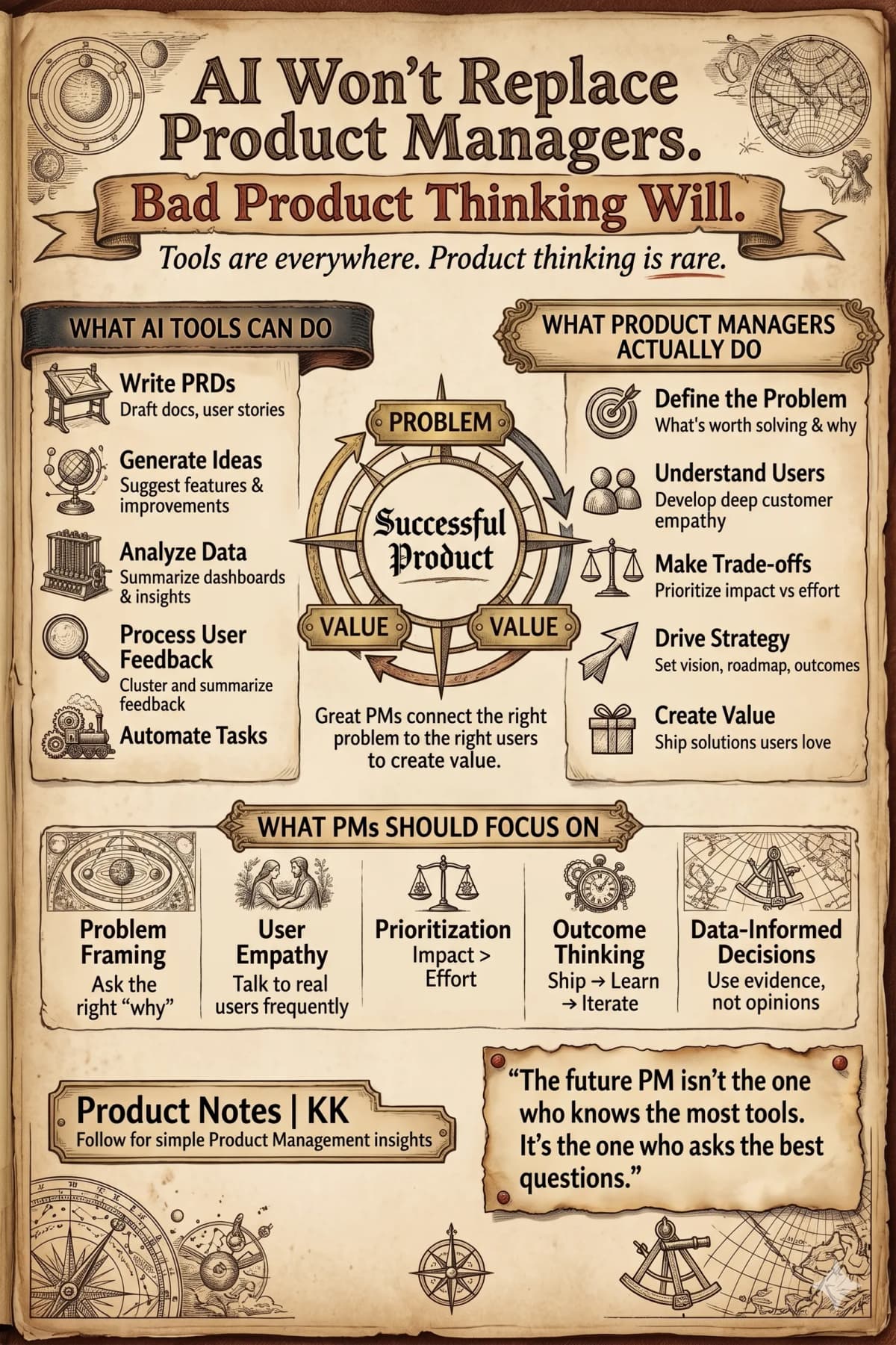
Scroll any PM community right now — r/ProductManagement, Lenny's Slack, Mind the Product — and the same pattern emerges. The PMs shipping faster in 2026 are not the ones who bought the most AI tools. They are the ones who developed a working philosophy about where AI helps, where it quietly hurts, and how to build personal systems around it. Here is what that philosophy looks like in practice.
Power Armor, Not Robot Friends
The most successful AI-enabled PMs use LLMs to augment their capabilities — insights, synthesis, speed — rather than to automate the decision itself. Models are notoriously bad at reading organizational nuance and stakeholder politics. They will happily generate a confident recommendation built on none of the unwritten context that actually drives the choice. Treat the output as a sharper first draft of your own thinking, never as the final verdict. The PM is still the one accountable in the room.
Build a “Project Brain”
Stop starting fresh chats. Use Projects in Claude or Custom GPTs in ChatGPT to host your PRDs, persona docs, roadmap, metric definitions, and strategy memos. This gives the model a long-term memory of your specific product context, so it stops hallucinating generic advice and starts responding inside your actual constraints. Pair this with the PARA method (Projects, Areas, Resources, Archives) for keeping the source material organized, and a CLAUDE.md-style instruction file at the root so the agent knows your team's voice, abbreviations, and guardrails.
Vibe Coding & Prototyping
A growing share of PMs are no longer waiting for engineering bandwidth to show an idea. They build rough, functional prototypes with AI IDEs like Cursor or low-code builders like Lovable and Replit, then walk engineers through a real click-through instead of a slide deck. The point is not to replace engineering — it is to eliminate the ambiguity gap between “what I described” and “what got built.” Show, don't tell. Technical PMs are going a step further and using Cursor to index their entire company repo, then asking questions like “if we change this field, what else breaks?”
Human-in-the-Loop Writing
The community-favorite technique is the “word vomit” method: dictate your messy thoughts into an LLM, let it organize them into a structured PRD or exec email, then edit 100% of the output by hand. Strip the corporate fluff, the em-dash tics, the “it's worth noting that...” filler, and every factual claim the model generated without evidence. What you keep is your thinking, made legible faster. What you cut is the AI fingerprint that kills trust when a senior leader spots it.
The Stack Most PMs Actually Use
- Claude — cited repeatedly on Reddit as the strongest model for PRD drafting, nuanced writing, and logical reasoning without the ChatGPT “AI-isms.”
- Cursor — AI code editor. Index your repo, then ask upstream-impact questions in plain English.
- Granola / Fireflies — meeting transcripts. Feed them into Claude to extract pain themes or jobs-to-be-done.
- Gamma — turn data-heavy notes into exec decks using the Pyramid Principle: lead with the answer, then stack supporting points.
- n8n / Zapier — build small agents that watch Slack channels or support tickets, cluster them by sentiment, and surface emerging trends.
Five Prompts Worth Stealing
A fuller library lives below. These five are the ones working PMs reach for weekly:
- Edge-case discovery— “I am building [Feature X] for [Persona Y]. Here is the current workflow. Identify 10 edge cases, technical constraints, or user friction points I might have missed.”
- Synthesis— “Take these 5 raw customer interview transcripts. Using the Pyramid Principle, summarize the top 3 pain points and the supporting evidence for each.”
- User stories— “Based on this PRD snippet, write 5 user stories in Gherkin format (Given/When/Then) specifically for the [mobile/web] experience.”
- SQL generation— “Using this schema [paste], write a SQL query to find 30-day retention for users who triggered 'Event A' at least three times.”
- Skeptical roleplay— “Act as a skeptical CTO. Review this roadmap and surface the biggest technical risks and architectural flaws in the Q3 plan.”
Further Reading for New PMs
The resources below are the ones experienced PMs hand new hires on day one. Bookmark, don't binge.
Communities
- r/ProductManagement — unvarnished PM reality.
- Mind the Product — global PM community, conferences, and articles.
- Lenny's Newsletter & Slack — the de-facto PM water cooler.
- Silicon Valley Product Group — Marty Cagan's essays. Required reading.
Writers Worth Following
- Teresa Torres — Product Talk — continuous discovery, the canonical source.
- Shreyas Doshi — clearest thinker on PM craft and prioritization.
- John Cutler — The Beautiful Mess — systems thinking for product teams.
- Aakash Gupta — Product Growth — tactical playbooks with receipts.
- First Round Review — deep interviews with operators.
Courses & Deep Dives
- Reforge — advanced PM, growth, and strategy programs.
- Product School — structured beginner-to-senior paths.
- Exponent — PM interview prep, mock sessions included.
- Nielsen Norman Group — the UX research canon every PM should know.
AI Foundations for PMs
- OpenAI Academy — free primer on LLMs, embeddings, fine-tuning.
- Anthropic Prompt Engineering Guide — the definitive prompt reference.
- DeepLearning.AI Short Courses — free, practical, one-hour deep dives.
- OpenAI Cookbook — real examples for everything from RAG to evals.
None of this matters without reps. Pick one tool, one prompt, one workflow — and use it on real work this week. That is the only loop that compounds.
Essential AI Tools for PMs
The tools leading product managers are using every day
Claude
Research & WritingDraft PRDs, synthesize user research, analyze competitive landscapes, and brainstorm product strategy. Claude excels at long-form analytical writing and can process large documents to extract actionable insights.
ChatGPT
General AssistantA versatile assistant for quick brainstorming, data analysis with Code Interpreter, generating user personas, and creating presentation outlines. Strong at multi-turn conversations that refine ideas iteratively.
Notion AI
DocumentationSummarize meeting notes, auto-generate action items, improve spec writing quality, and keep your product wiki organized. Integrates directly into your existing Notion workspace for seamless workflow.
GitHub Copilot
Technical PMsReview pull requests more effectively, write SQL queries for data analysis, prototype simple tools, and better understand your team's codebase. Essential for PMs who work closely with engineering.
Perplexity
ResearchConduct market research with real-time sourced answers, track competitor announcements, find industry benchmarks, and validate assumptions with up-to-date data — all with cited sources you can verify.
Midjourney
Design MockupsGenerate concept art for product visions, create placeholder UI illustrations, visualize marketing assets, and quickly communicate visual ideas to design teams before investing in polished mockups.
PM Prompt Library
Copy-ready prompts to supercharge your PM workflow
A prompt is a draft.
A Staff PM is a sparring partner.
Run your strategy, your launch plan, your metric choice past an AI Staff PM who pushes back with the hard questions execs actually ask. No fluff, no validation loops — just the friction that sharpens your thinking.