A species introduction
In the fluorescent-lit savannas of the modern office — and, increasingly, the beige home-office ecosystems of converted guest bedrooms — a fragile, fascinating creature emerges each quarter: the Newly Minted Product Manager. Shy at first, prone to sudden bursts of confidence followed by 2 a.m. Googling, this species has become a fixture of the contemporary tech environment.
What follows is what the careful observer should know.
Habitat & range
The New PM is most commonly sighted in Slack channels, Jira boards, and the third Zoom meeting of the day. Preferred roosting sites include the specific corner of the office where one engineer sighs loudly. In colder climates — Canada, parts of the American Midwest, any HR department — the New PM may retreat deep into a tab-hoard of Miro boards and unread wiki pages, emerging only when someone utters the word alignment.
Range has expanded dramatically in the last decade. Populations once confined to San Francisco are now found thriving in Montreal, Toronto, Austin, Berlin, and anywhere else a laptop, strong opinions about push notifications, and a paid LinkedIn membership can be assembled in one place.
Distinguishing features
The New PM may be identified by a distinctive plumage: a soft-shell jacket, a branded tote from last year's off-site, and a note-taking app so deeply nested you could lose a small dog in it. Plumage brightens when they discover a new prioritization framework, which they will then attempt to apply to every situation in their life, including where to eat lunch (the rice bowl scores highest; they are aware of the pun).
Posture is unmistakable. At rest: leaning slightly forward toward a screen, nodding. In flight: sprinting between a design review and a “quick sync.” They carry at all times a notebook they will never re-open.
Diet
The New PM is an omnivore, but subsists primarily on the following:
Frameworks
Consumed whole and regurgitated into decks.
Coffee
Treated as a load-bearing nutrient.
Feedback
Which they claim to love and secretly metabolize as anxiety.
Feature requests
Stored in their roadmap the way a squirrel stores acorns — confident each one matters, unsure which they'll actually need.
Curiously, the New PM will often confuse shipping with nourishment, producing features the way a stressed raccoon eats garbage: rapidly, indiscriminately, and with a vague sense that this cannot be what dinner is supposed to look like. Field biologists have several clinical terms for this behaviour, but the New PM rarely encounters these terms until their second year, by which point they are already deep in it and publishing LinkedIn posts about what they've learned.
Calls & vocalizations
The vocal repertoire of the New PM is narrow but deeply felt:
“Let me circle back on that”
A soft cooing, used when cornered.
“That's a great question”
A distress call, emitted when it is not a great question.
“I want to make sure we're aligned”
A mating call. Rarely successful.
“Let's take that offline”
Warning cry; signals incoming conflict avoidance.
“Walk me through your thinking”
Stalling vocalization; buys roughly ninety seconds.
In the wild, these calls escalate in pitch and frequency as a quarterly review approaches. By week eleven of the quarter they are audible only to dogs and skip-level managers.
Social behaviour
The New PM is a pack animal that believes itself to be a lone wolf. They depend entirely on engineers, designers, data analysts, and one extremely patient person in customer support who actually knows what the product does — yet will routinely describe themselves as “at the centre of everything,” which is both charming and, from the engineers' perspective, hilarious.
Dominance hierarchies are complex. The New PM appears to be subordinate to everyone and, simultaneously, responsible for everything. They have no authority and infinite accountability. Researchers are still studying how the species survives this at all. Early hypotheses point to caffeine and a stubborn, almost tragic optimism.
Predators
The New PM has few natural predators, but several environmental threats:
The HiPPO
A large, loud mammal — officially the Highest Paid Person's Opinion — that stomps into any meeting and changes the roadmap with a single “what if.” Evasive manoeuvres are rarely successful. Camouflage, in the form of a well-sourced chart, is the species' best defence.
The Sales Promise
A feature, sold in Q1, that the New PM learns about in Q3. Often arrives with a firm deadline and no requirements document.
The Stakeholder Ambush
A sudden request disguised as a “quick question.” Never quick. Rarely a question.
Their Own Notifications
A self-inflicted threat. Widely studied. Rarely addressed.
Mating displays
Rarely observed in public. Most courtship behaviour happens inside retro meetings, where the New PM will attempt to impress the group by admitting a mistake in exactly the right proportion — enough to seem self-aware, not enough to seem incompetent. Success is measured in slow nods from senior engineers. Failure results in an action item.
Conservation status
The New PM is, against all reasonable expectation, thriving. Despite a habitat increasingly disrupted by AI tools, hiring freezes, and the creeping suspicion that nobody actually knows what strategy means in their own org, the species adapts.
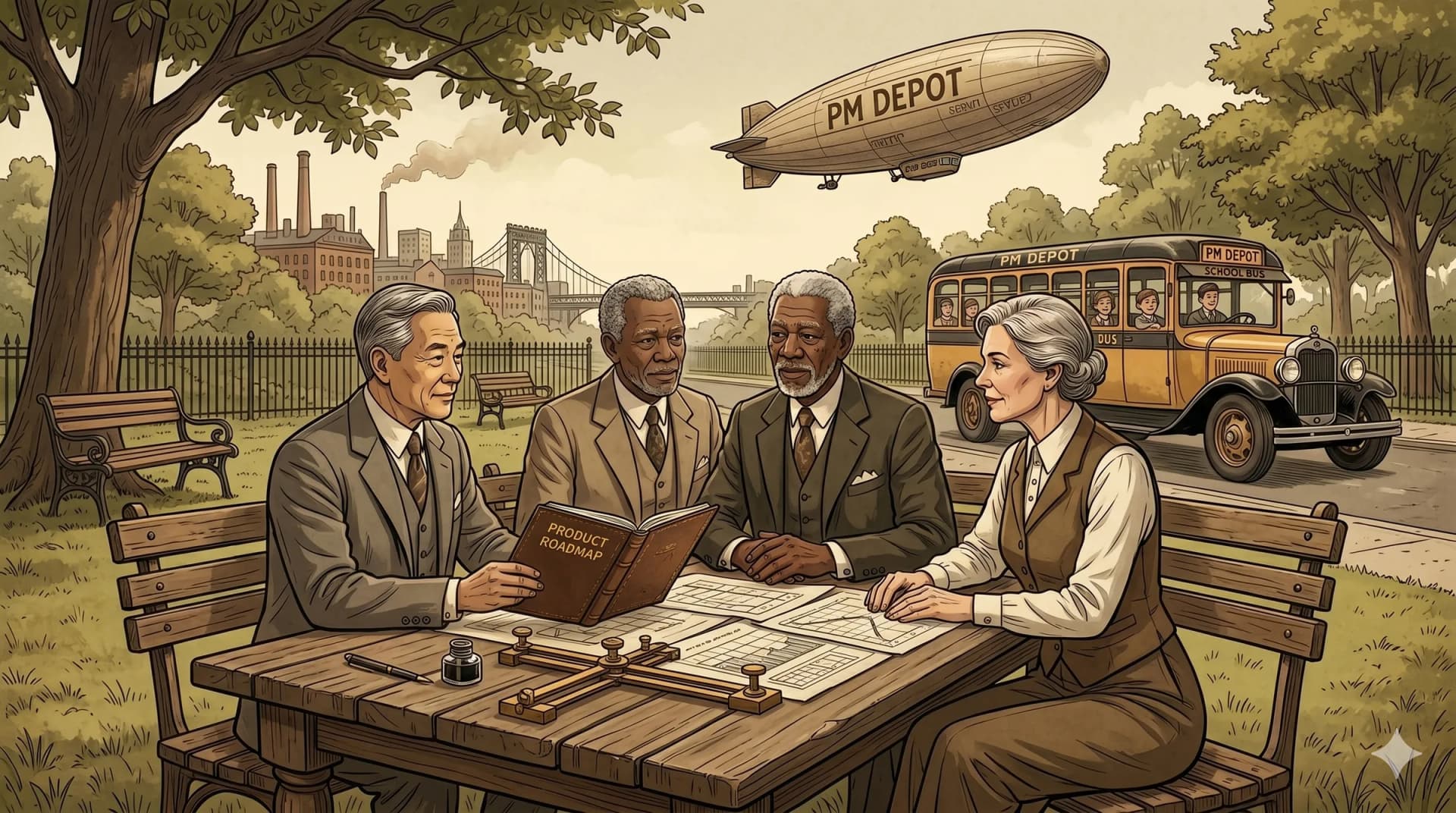
Those that survive the first year emerge changed: quieter, funnier, gentler with their engineers, suspicious of any framework that needs more than one slide to explain, and deeply skeptical of any plan that cannot be written on a napkin. They develop an ear for which meetings matter. They learn that the roadmap is a living document in the way a houseplant is a living document — alive, yes, but mostly dependent on whether anyone remembers it this week.
Field note
A closing note from the field
The Newly Minted Product Manager is, at their core, a hopeful creature. They believe a better product is possible. They believe meetings could end on time. They believe this roadmap — the new one, the good one — will finally hold.
These beliefs are, statistically, mostly wrong. Which is precisely what makes the species endearing, and precisely why the habitat needs them.
“Observe respectfully. Do not feed them more frameworks. They have enough.”
— Field Notes on the First-Year Product Manager