The Product Roadmap Vibe Check: Why Your Spreadsheet is Basically Fan Fiction
PM DEPOT
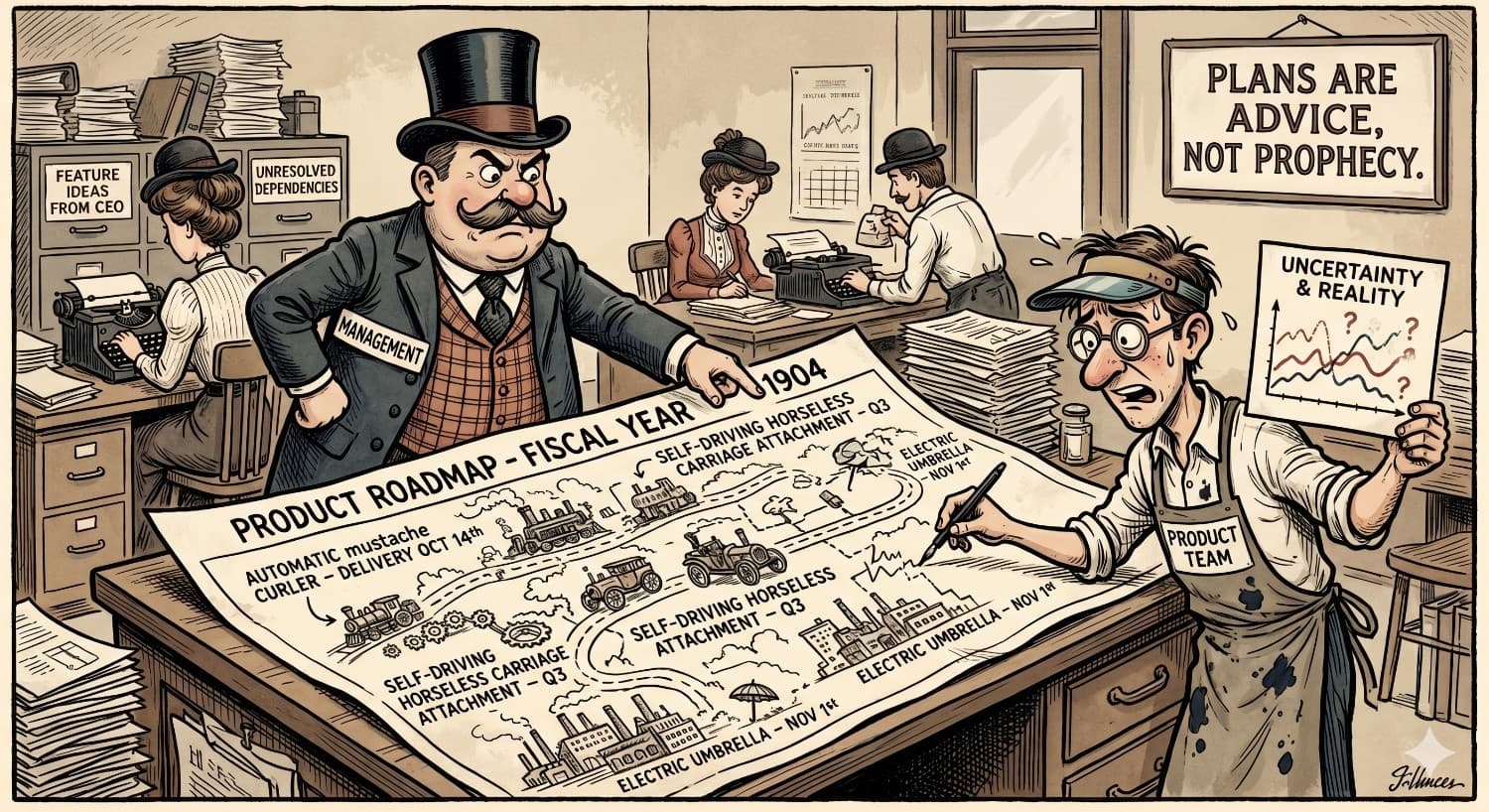
tl;dr: Traditional roadmaps are basically corporate fan fiction that ends in burnout. To survive the chaos of 2026, you need to ditch the fake deadlines and switch to a "Now Next Later" framework. It keeps your stakeholders informed without turning your life into a series of broken promises.
The Trauma of the Infinite Spreadsheet
We need to have a real conversation about product roadmaps. I still have a core memory from a startup where our "strategy" was just an Excel sheet overflowing with random feature ideas. Most of them were "gentle suggestions" from the CEO that our Head of Product just shuffled around like a sad deck of cards. Nobody knew why. We just did it.
This isn't just a "me" problem. It is a massive industry red flag. Most teams define a roadmap as a grocery list of features with arbitrary expiration dates attached. We try to dress them up as "themes," but let’s be honest: those are usually just features wearing a trench coat. It feels like we’re all just participating in a collective hallucination where we pretend to know exactly what we’re building six months from now.
The Traditional Roadmap is a Major Red Flag
The old-school roadmap (features plus dates) is the ultimate security blanket for people who hate uncertainty. It looks great in a Slide deck. It makes the Board feel like everything is under control.
| Team | Q2 | Q3 | Q4 |
|---|---|---|---|
| Search | AI Vibe Check | Filter Refresh | Saved Search |
| Onboarding | Welcome Vibes | Tutorials | Wizardry |
This format gives the "main character" energy to Sales and Marketing because they get exactly what they want: a date to put on a calendar. For stuff that is literally being coded right now or required by law, this is fine. But for anything further out? It is a trap.
Why We Keep Ghosting Our Deadlines
As roadmap legend Janna Bastow points out, these date-heavy grids are built on three total lies. First, you think you know how long things take (you don't). Second, you think the feature will actually work on day one (it won't). Third, you think every idea on that list actually deserves to exist (most don't).
When you treat a roadmap like a legal contract, you are destined to fail. Everyone on the product team knows the dates are fake, but the rest of the company treats them like a pinky promise. When the "contract" inevitably breaks, the vibes go rancid and trust evaporates.
The "Now Next Later" Glow Up
In 2012, we finally got a better option. The Now Next Later framework acknowledges that the future is messy. It’s less of a static document and more of a "choose your own adventure" for your strategy.
- Now: The stuff we are actually doing. It is spec’d, it is being built, and we can actually talk about dates.
- Next: The stuff on deck. We know the problem we want to solve, but we haven't committed to the "how" yet.
- Later: The "vibes" section. These are just ideas on our radar. No promises. No stress.
This is the ultimate compromise. It tells the rest of the org what is coming without locking the devs into a feature that might not even work.
The Pro Move: Adding the Discovery Layer
If you want to reach God-tier product management, you don't just put features in these columns. You change the type of content as you move across the timeline. This is where you bring in the Opportunity Solution Tree (OST) energy.
| Team | Now (Solutions) | Next (Opportunities) | Later (Outcomes) |
|---|---|---|---|
| Search | AI Beta | "I can't find anything." | Speed to result |
| Onboarding | New Flow | "I'm lost and confused." | Time to value |
In the "Now" column, you give them the concrete features. In the "Next" column, you talk about the customer pain points you are going to tackle. This lets Sales talk to prospects about the problems you are solving instead of promising a specific button that might change. By the time you get to "Later," you’re just talking about the big-picture goals.
How to Soft Launch This Transition
You don't need to delete your current roadmap and start a riot. Just start where you are. If your boss demands a feature list, give it to them, but add a little "Outcome" tag to every item. Start explaining that while the solution might pivot, the goal stays the same.
Use the chaos of the current market to your advantage. If everyone is screaming for "AI features" but nobody knows how they work yet, that is your perfect excuse to use the Now Next Later format. Tell them: "We are testing the tech now so we can solve the problem next."
Roadmaps should reflect reality, not your wish list. Keep it specific for today and directional for tomorrow. Your mental health will thank you.
Recommended Resource
Put It Into Practice
How would you handle it in the room?
Step into the simulator — test your PM instincts against real stakeholder pressure. No slides. No safety net.
Enter the Simulator