The Post-Hype PM: A Veteran’s Guide to Shipping without Losing Your Mind
PM DEPOT
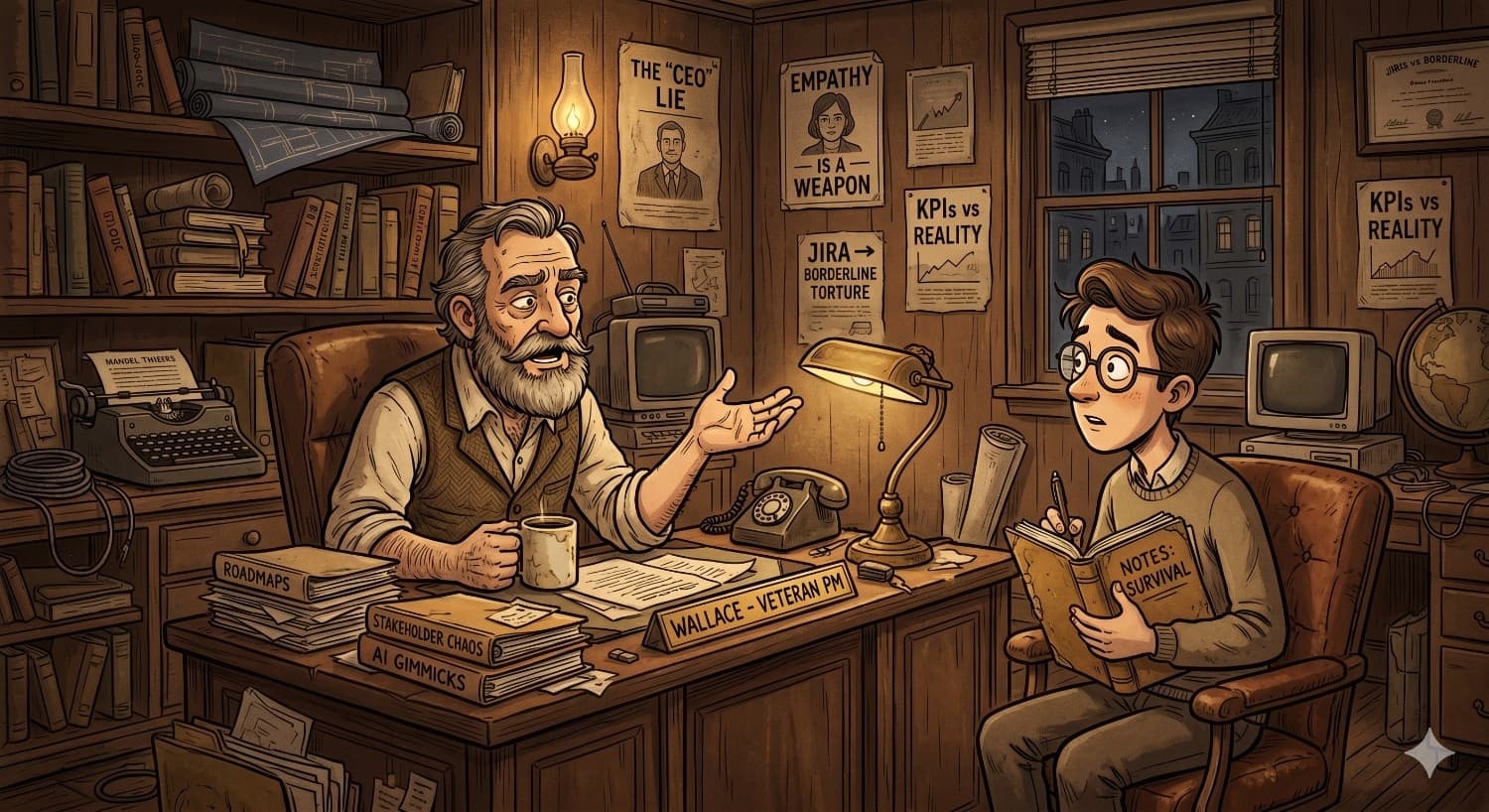
Read it because: This is a raw, conversational knowledge transfer between Wallace (a veteran Director of Product who’s seen every hype cycle from Agile to AI) and Joffre (a green PM). It covers the brutal reality that PMing is about managing people's anxieties, using AI as a tool for leverage rather than a crutch, and surviving the "feature factory" grind.
The Handover
Wallace leaned back in his Herman Miller, the kind with the mesh that had probably seen three different startup exits. He didn't look like a guy retiring; he looked like a guy who had just been cleared of a crime he actually committed. He took a sip of a triple-shot oat latte that was definitely cold. Joffre sat across from him, laptop open, looking like he was ready to transcribe a sermon.
I’m not going to give you a slide deck, Joffre. Slides are for people who want to hide the fact that they don't have a strategy. I’m giving you the mental models. I’ve been shipping since the days when we thought 'the cloud' was a revolutionary concept and not just someone else’s server in a warehouse. I’ve lived through the 'Pivot to Video,' the 'Web3 Fever Dream,' and now the 'AI Gold Rush.' You’re coming in at a weird time. The tools are smarter, but the people? They’re just as confused as they were in 2010.
Joffre tapped a key on his laptop. I’m ready. I’ve been reading up on the AI-first PM workflow. I want to make sure I’m hitting my KPIs from day one.
Wallace groaned, a sound that started in his chest and ended in a sigh. KPIs. God. Look, KPIs are fine for the board, but don't let them become your personality. You want to know what your actual job is? You are a professional uncertainty reducer. People come to you because they are scared. The CEO is scared of the board. The engineers are scared of technical debt. The customers are scared their problems won't get solved. You? You’re the one who looks at the mess and says, 'Here is the path.' Even if you’re lying a little bit about how clear the path is.
The Great PM Illusion
But what about the 'CEO of the Product' thing? Joffre asked, his voice a little shaky. My bootcamp mentioned that every thirty minutes.
Wallace let out a dry, hacking laugh. If I were the CEO, I’d have a much better exit package. You have all the accountability and none of the power. You can't fire the lead dev who refuses to use the new API, and you can't tell the Head of Sales to stop promising features that don't exist. You lead through influence, or as I like to call it, 'strategic nagging.' You have to make people think your ideas were their ideas. It’s like Inception, but with more Jira tickets and less cool suits.
So how do I actually get things done if I don't have authority? Joffre asked.
You find the 'Why.' Not the corporate why, the human why. Why does the engineer want to rewrite the backend? Is it because the current one is broken, or because they’re bored and want to put a new framework on their resume? Why does the stakeholder want that specific dashboard? Is it for data, or so they can show their boss they’re 'data-driven'? Once you find the real motivation, you can negotiate. Product management is 20% strategy and 80% navigating adult egos.
The Roadmap is a Fever Dream
Joffre pointed at the monitor. I saw the Q4 roadmap. It’s... ambitious.
It’s a work of fiction, Wallace said flatly. It’s a fairy tale we tell the stakeholders to keep them from screaming. The moment you put a date on a feature six months out, you’ve committed a crime against logic. The world changes. A competitor drops a new LLM integration. Your lead designer quits to join a goat farm in Vermont. The roadmap should be a list of problems you want to solve, not features you want to build.
But the stakeholders want dates, Joffre countered. They need to plan marketing.
Give them windows, not dates. Give them 'Now, Next, Later.' And every time you add something to 'Now,' make them pick something to move to 'Later.' It’s the law of equivalent exchange, kid. You can’t put more water in the bucket without it overflowing. If they want the 'Shiny New AI Chatbot' by October, ask them which part of the core checkout flow they’re okay with breaking. They’ll hate you for it, but they’ll respect the honesty. Eventually.
AI as a Force Multiplier not a Replacement
I’m worried about AI taking the 'Management' out of Product Management, Joffre admitted. If it can write the PRDs and analyze the telemetry, what am I for?
Wallace leaned forward, his grizzled face illuminated by the glow of three different monitors. AI is a god-tier intern. It can summarize five hundred customer interviews in ten seconds. It can write a decent first draft of a technical spec. But AI doesn't have skin in the game. When a launch fails and the stock price dips, the AI doesn't get a panicked 2:00 AM call from the VP of Product. You do.
The AI can tell you what happened, but it can't tell you the nuance of why. It can't feel the tension in a room during a sprint planning session. Use AI to automate the boring stuff—the status updates, the ticket descriptions, the data crunching. That frees you up to do the hard stuff: talking to humans. If you’re spending your day writing Jira tickets, you’re failing. You should be spending your day listening to people complain until you find the pattern in their misery. That pattern is your product.
The Dark Art of Stakeholder Management
So, how do I handle the 'HiPPO'? Joffre asked, using the acronym for Highest Paid Person’s Opinion.
Ah, the HiPPO. Wallace leaned back. They usually come in with a 'vision' they had while eating a $40 salad. You don't tell them no. You tell them 'Yes, and.' You show them the cost. Use the data. 'I love that idea, boss. Based on our current velocity, building that would mean delaying the security patch that keeps us from getting sued. Should we prioritize the vision or the legal compliance?' Always frame it as a choice. People love choices. They hate being told they’re wrong.
Joffre scribbled something down. What if they choose the wrong thing?
Then you document it, you ship it, and you prepare the 'I told you so' in a way that sounds like 'We’ve learned a lot from this experiment.' That’s the grizzled PM way. You build scar tissue. Eventually, you’ll have enough to be bulletproof.
The Empathy Weapon
The bootcamp said I need to have empathy for the user, Joffre said, looking a bit confused.
Empathy isn't just a soft skill, Wallace grunted. It’s a tactical advantage. If you actually understand the user’s pain, you can build the thing they’ll pay for. Most users don't want a 'seamless experience.' They want to finish their task and go see their family. They want to not feel stupid when they use your app. If you can make a user feel like a genius for five minutes a day, you’ve won.
And empathy for the devs?
Vital. They’re the ones in the trenches. If you treat them like code-monkeys, they’ll give you code-monkey results. If you involve them in the problem-solving, if you treat them like partners, they’ll save your ass when the server melts at midnight. Be the PM who brings donuts—or the high-quality digital equivalent. Protect their time. Be the shield that keeps the corporate bullshit from hitting their keyboards.
The Final Handoff
Wallace stood up and grabbed a small, dusty box from his desk. It contained a mechanical keyboard and a very old laptop sticker that said 'Move Fast and Break Things.'
That sticker is a lie, by the way, Wallace said, tossing it into the trash. Move deliberately and fix things. We’ve broken enough stuff over the last decade. It’s time to actually build things that work.
Joffre stood up, looking slightly more confident, or maybe just overwhelmed in a more professional way. Thanks, Wallace. I think I get it. It’s not about the features. It’s about the people.
It’s about the friction, Joffre. Find the friction, name it, and kill it. Everything else is just noise. Now, if you’ll excuse me, I have a date with a beach and a complete lack of notifications. Don't call me. I’m deleting Slack the second I hit the elevator.
Wallace walked out, his steps lighter than they’d been in years. Joffre sat down in the Herman Miller, opened his laptop, and stared at the empty Q1 roadmap. He took a deep breath, opened an LLM to help him summarize the 'unfiltered' notes he just took, and smiled. The chaos was his now.
Put It Into Practice
How would you handle it in the room?
Step into the simulator — test your PM instincts against real stakeholder pressure. No slides. No safety net.
Enter the Simulator