The Great Flattening: Why Your Job Title Doesn't Mean What It Used To
PM DEPOT
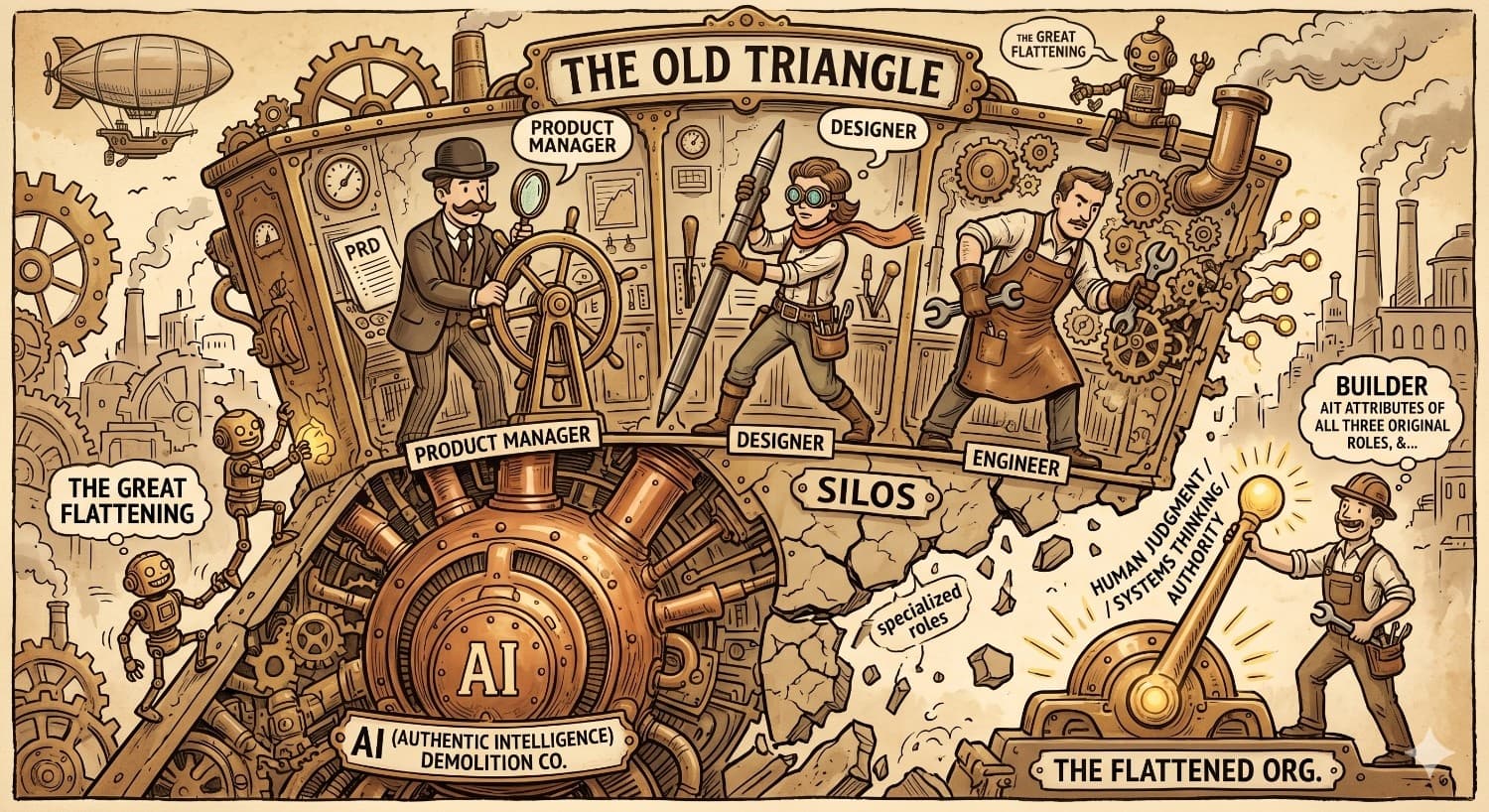
tl;dr: The traditional walls between PMs, Designers, and Engineers are crumbling as AI democratizes technical skills. Success now depends on unique human traits: judgment for designers, systems thinking for engineers, and organizational authority for PMs.
       _______________________________
      |  ___________________________  |
      | | PIXELS | CODE | STRATEGY | |
      | |________|______|__________| |
      |      \         |         /   |
      |       \      AI REPO    /    |
      |        \_______|_______/     |
      |_______________________________|
The End of the Specialized Silo
For decades, we lived in a world of hand-offs. As a Product Manager, I’d spend my weeks living in the "fuzzy front end"—gathering requirements, obsessing over KPIs, and trying to articulate a vision. Then, I’d hand a messy brief to a designer who would spend weeks making it concrete. We needed each other because we were trapped by our own technical limitations. I couldn't draw a high-fidelity interface to save my life, and the designer often didn't have the data tools to build a business case.
That wall has been knocked down. Today, with the right AI stack, I can move from a vague "onboarding churn" problem to a clickable, high-fidelity prototype in ninety minutes. I can generate thirty UI variations while my designer is still finishing their first coffee. The "craft" of making things visible is no longer a gated community.
When Everyone Becomes a Generalist
It’s not just PMs "playing" designer, either. The knife is incredibly sharp on both sides. I’ve seen designers using LLMs to run complex SQL queries, build prioritization matrices, and draft PRDs that are frankly better than what some mid-level PMs produce. If a designer can synthesize market data, build a financial model, and visualize the solution, the traditional PM starts to look like a redundant middleman.
Then you have the engineers. The old "just give me the Figma file" attitude is dying. An engineer with AI can now generate competent (if not beautiful) layouts and write their own UX copy. They are no longer just the "builders"; they are becoming self-contained product squads. The "Triangle" of Product—Design, Engineering, and PM—is collapsing into a single, blurry point.
          /\
         /  \  <-- THE OLD TRIANGLE
    PM  /____\  DESIGNER
        \    /
         \  /
          \/
       ENGINEER
          ||
          VV
        [ AI ] <-- THE NEW SINGULARITY
The Skills That Won’t Be Automated
If anyone can code, anyone can design, and anyone can write a spec, what are we actually paying people for? As a PM, looking at the wreckage of these dissolving boundaries, I see three "Durable Advantages" that AI can't touch.
The Designer’s Edge: Contextual Judgment AI can give you twenty beautiful layouts, but it can’t tell you which one will make a user feel safe or inspired. It doesn't understand the nuance of brand trust or when to intentionally break a design pattern to solve a unique human problem. That "taste" is actually a deep library of human empathy and experience.
The Engineer’s Edge: Systems Foresight AI is great at writing functions; it’s terrible at understanding what happens to a global architecture when a database migration fails at 3:00 AM under peak load. The real value of an engineer isn't "typing code"—it's the mental model of how complex systems interact and fail. It’s the ability to see the car crash three miles down the road before the car even starts.
The PM’s Edge: The Knife of Authority This is the hardest truth: the PM’s primary value is increasingly becoming Organizational Power. AI can suggest what to cut, but it can't walk into a boardroom and tell a VP that their favorite feature is being killed. Someone has to own the outcome, take the blame, and navigate the messy politics of human egos and resource allocation.
          (O)
        /  |  \
     JUDGMENT | SYSTEMS
        \  |  /
         POWER
The New Product Reality
We are moving toward a world where the three-role team might have been a workaround for a lack of tools, rather than the "optimal" way to build. If technology removes the friction of doing the work, we are left with the much harder task of deciding what is worth doing.
The title on your LinkedIn profile is becoming less of a description of your tasks and more of a description of your perspective. We’re all builders now. The only question left is: do you have the judgment and the guts to build the right thing?
Put It Into Practice
How would you handle it in the room?
Step into the simulator — test your PM instincts against real stakeholder pressure. No slides. No safety net.
Enter the Simulator