Stop Polishing Slides and Start Solving the Mess
PM DEPOT
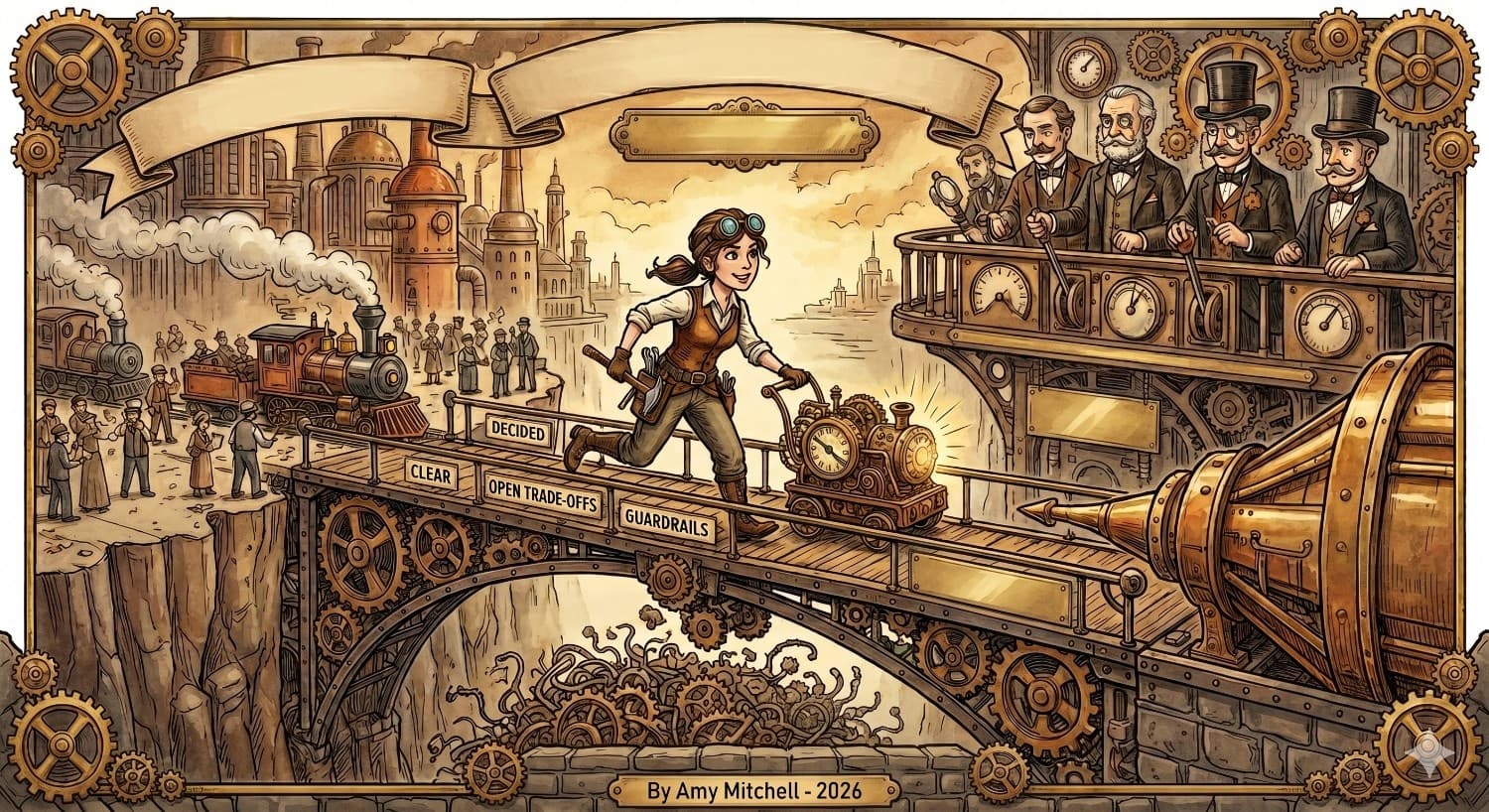
tl;dr: This rewrite shifts the focus from "giving updates" to "managing a living problem." It highlights a system where you treat leadership as active participants in solving complex issues rather than passive observers of your progress.
The Scaling Trap
You just landed a few major customer wins. They weren't "clean" wins—you were the glue holding sales, finance, and engineering together just to get the wheels turning. Now, leadership asks the dreaded question: "How do we scale this?"
Your instinct is to go hide for a week and build a perfect 20-slide deck. Don't. When you’re in the "builder" phase of product management, executives aren't looking for a finished masterpiece. They are looking for a way to help shape the solution while it’s still malleable. They want to understand the trade-offs and the friction points, not just the highlights.
       o
      / \
     /   \
    /     \
   /       \
  [_________]
   | PM    |  <-- You are here:
   | BRIDGE|      Connecting the mess
  _|_______|_     to the vision.
Own the Problem, Not the Status Report
Most PMs treat executive engagement as a chore—a distraction from the "real work." High-impact PMs realize that executive engagement is the work. If you handle this transition poorly, you become a human bottleneck, or worse, you lose alignment and the whole project stalls.
The goal isn't to provide a better update; it’s to build a system where the work evolves, leaders stay engaged at the right altitude, and the project moves toward a final decision.
Anchor to One Constant Question
Exec meetings often spiral because the goalposts move every week. One day it’s about speed, the next it’s about cost. You need to anchor the room to a single, persistent question that remains the same until the problem is solved.
- Example: "What are the three things that must be true for this to work for every customer?"
By keeping this question at the top of every interaction, you create a sense of momentum. Updates aren't just random facts; they are evidence of you getting closer to answering that one big question.
    _________________
   |  THE BIG Q      |
   |_________________|
          |
    ______|______
   |             |
 [Data]       [Wins]
Show Convergence, Not Effort
Executives don't care about your "learnings" or how many people you interviewed. They care about whether the problem is shrinking. Instead of listing activities, translate your progress into:
- Decided: What is no longer a debate.
- Clear: What we now know for a fact.
- Open: The specific trade-offs where we still need leadership input.
This makes the work feel like it’s narrowing toward a finish line rather than expanding into more complexity.
The Two-Track Strategy
The actual work is messy and full of dead ends. Your leadership narrative should not be. You need to run two parallel tracks:
- The Wide Track: Where you and the team explore every edge case and messy detail.
- The Narrow Track: Where you only surface the pieces that actually influence a decision.
If you show too much too early, you invite "opinion creep." If you show too little, leaders disengage or swoop in at the last minute with a "re-org" of your ideas.
   \          /
    \ Tracks /
     \      /
      \    /
       |  |  <-- Narrow Narrative
       |__|
Design for the Exit
Every complex problem should have an expiration date. You aren't managing this problem forever; you are structuring it so it can eventually be operationalized and handed off. Closing loops aggressively—stating clearly why a path was abandoned—prevents old questions from resurfacing and dragging you backward.
When you run the problem this way, you aren't the person carrying the weight alone. You are the architect of the solution, building trust with senior leaders by showing them you can navigate chaos and bring it to a controlled landing.
Put It Into Practice
How would you handle it in the room?
Step into the simulator — test your PM instincts against real stakeholder pressure. No slides. No safety net.
Enter the Simulator