Pricing models simplified
PM DEPOT
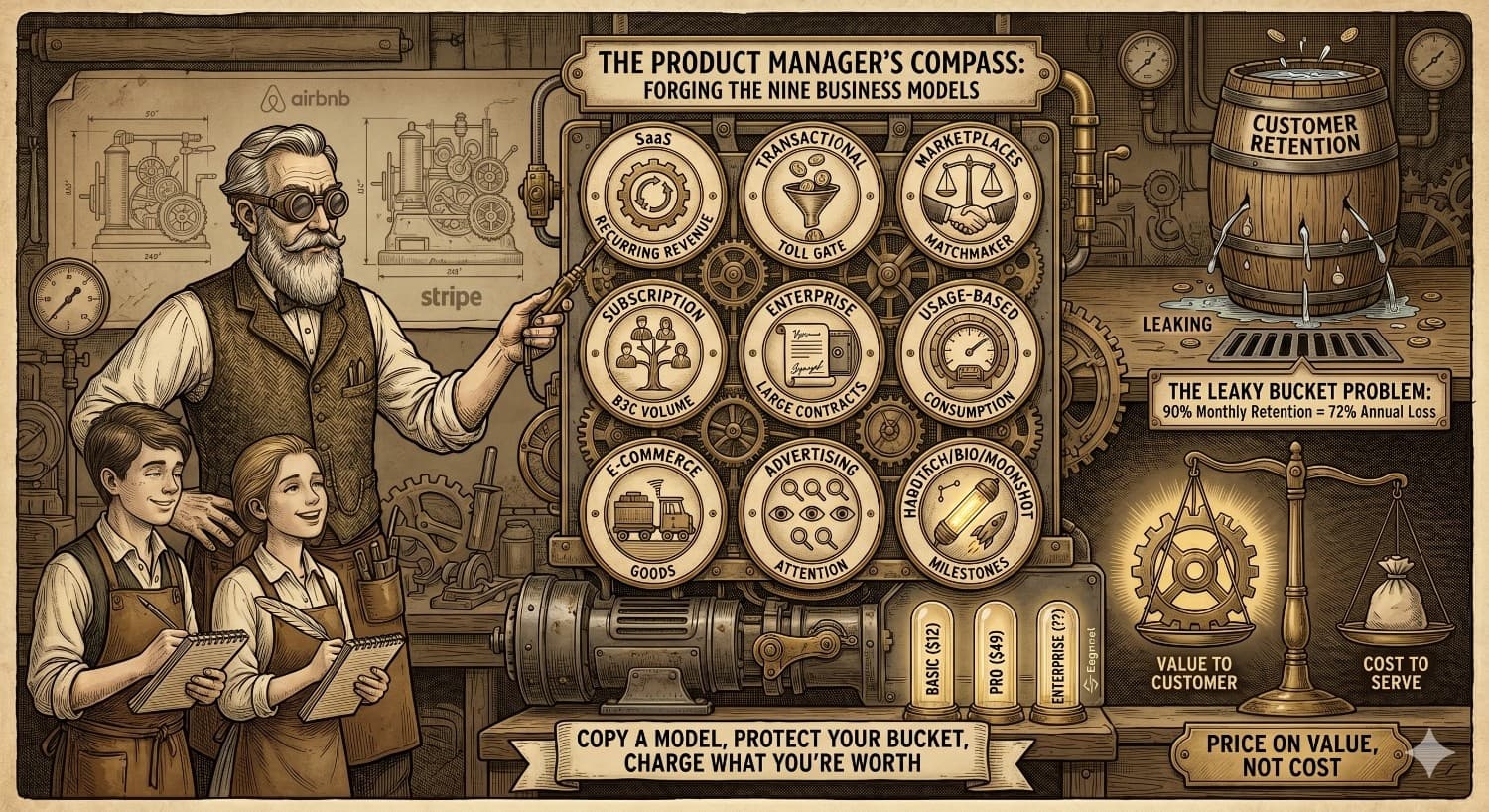
TL;DR: Successful companies don't reinvent the wheel—they pick one of nine proven business models. As a Product Manager, your primary job is to protect the "leaky bucket" (retention) and have the backbone to price based on the massive value you provide, not the meager cost of your servers. Stop undercharging, stop overcomplicating, and start building moats that last.
Sit down, kid. Lean in close. You want to talk about "disruptive innovation" and "game-changing paradigms"? Fine. But if you can’t tell me exactly how your product puts money in the bank at 3:00 AM while you’re asleep, you don’t have a business—you have a very expensive hobby.
I’ve spent decades in the trenches of product management. I’ve seen companies go from zero to billion-dollar exits, and I’ve seen "brilliant" ideas burn through fifty million in VC cash before hitting the dirt because they tried to get cute with their business model. Here’s the first piece of grandfatherly advice you’ll ever need: In business, being original with your business model is usually a death sentence. Being original with your product value is where the legends are made.
If you’re a junior or intermediate PM, you’re likely obsessed with the "what"—the features, the UI, the user flow. That’s cute. But the senior folks, the owners, the people who actually move the needle? We obsess over the "how." How does value flow? How does it stick? And how do we capture enough of it to keep the lights on and the growth engine humming?
Let’s walk through the nine ways the world actually works.
   _______
  |  ___  |
  | |   | |
  | |___| |
  |  ___  |
  | |   | |
  | |   | |
  |_|   |_|
  THE PILLARS
The Infinite Hamster Wheel of Software as a Service
SaaS is the darling of the venture capital world for a reason. It’s predictable. It’s scalable. It’s beautiful. You build a piece of software, host it in the cloud, and charge people a recurring fee to access it. Whether they use it every day or forget it exists, the check clears on the first of the month.
But here’s the trap: SaaS is a relationship, not a sale. In the old days, we sold software in a box. We got the money, and then we didn't care if the user ever installed it. Today, if you don't provide value every single day, the user clicks "Cancel," and your valuation drops like a stone.
You need to live and breathe Monthly Recurring Revenue (MRR) and its big brother, Annual Recurring Revenue (ARR). But the metric that separates the pros from the amateurs is Net Revenue Retention (NRR). If you have $100 today, and next year those same customers are giving you $120 because they upgraded or bought more seats—even without you signing a single new customer—you have a money-printing machine. That’s what we call "negative churn," and it’s the holy grail of product management.
Sitting at the Toll Booth of Global Commerce
If you want to feel the pulse of the world, look at Transactional models. Think Stripe, PayPal, or Coinbase. These businesses don't care about your "feelings" or your "engagement." They care about the flow. They sit right in the middle of a transaction and take a tiny sliver—usually 1% to 3%—of every dollar that passes through.
This is the "Toll Booth" model. Imagine owning a bridge. You don't care where the cars are going or why; you just care that they have to cross your bridge to get there. As a PM in this space, your entire world is Gross Transaction Value (GTV). Your job is to remove friction. Every extra click, every slow-loading page, and every confusing form field is a "pothole" on your bridge that makes cars turn around.
The beauty here is consistency. In high-repeat businesses, transactional revenue is as good as recurring revenue because the behavior is baked into the user's life. If I use my corporate card every day for lunch, that transaction is guaranteed. Your goal isn't to sell them once; it's to become the default rail they run on.
    / \
   /   \
  /_____\
  |     |
  | [ ] |
  |_____|
 THE TOLL GATE
Playing Matchmaker for a Billion Dollars
Marketplaces are the hardest businesses to start and the hardest to kill. Think Airbnb, DoorDash, or Uber. You have a "Chicken and Egg" problem on day one. You need drivers, but drivers won't come without riders. You need riders, but riders won't wait twenty minutes for a car.
But once you solve it? Oh, boy. You get Network Effects. This is the law that states the value of a network increases exponentially with every new user. If you’re the only person on Earth with a telephone, it’s a paperweight. If everyone has one, it’s the most valuable tool in history.
As a PM, you’re managing two different products at once: the Supply side and the Demand side. You have to balance them perfectly. If you have too much supply, your sellers get bored and leave. If you have too much demand, your buyers get frustrated and leave. You’re looking for Gross Merchandise Value (GMV) and your Take Rate (the % you keep). The winner-take-all nature of marketplaces is why investors lose their minds over them. Once Airbnb owned the "short-term rental" headspace, trying to compete with them became an uphill battle in a blizzard.
The Gym Membership Model for the Digital Age
Then we have Subscriptions, specifically for consumers. This is your Netflix, your Spotify, your Headspace. It looks like SaaS, but the psychology is different. B2B SaaS is about "ROI"—does this tool save my employees time? Consumer subscription is about "Identity and Entertainment."
The price points are lower, which means you need massive volume. You aren't doing direct sales calls with 5,000-person enterprises. You’re running A/B tests on your landing page to move a conversion rate from 2.1% to 2.3%.
The biggest danger here is "The Sleepy Subscriber." Many consumer businesses thrive on people who forget to cancel. But as a PM who wants to build a great company, that’s a dangerous game. Eventually, the "Great Unsubscribing" happens when the economy dips. You want "Active" users, not just "Paying" users. If they don't use the product, they are a churn risk waiting to happen.
Chasing Moby Dick in the Enterprise Jungle
If you like high stakes, long lunches, and massive checks, you want the Enterprise model. We're talking six-figure or seven-figure contracts sold to companies with 5,000+ employees.
Here, the "Buyer" is almost never the "User." The CIO signs the check, but the junior analysts use the software. As a PM, this is a mind-meld. You have to build features that make the User happy so they don't revolt, but you also have to build "Compliance," "Security," and "Reporting" features that make the Buyer feel safe.
Growth isn't a viral loop; it's a Sales Pipeline. You're tracking Demos, Paid Pilots, and Letters of Intent. It’s lumpy. You might go three months with zero revenue and then land a $2 million contract in a single Tuesday. It’s not for the faint of heart, but the "Lock-in" is incredible. Once a massive bank integrates your software into their workflow, it would take a literal act of God to get them to switch to a competitor.
   ________
  |  ____  |
  | |____| |
  |  ____  |
  | |____| |
  |________|
  THE CONTRACT
The Digital Utility Bill
Usage-Based models are the most honest way to do business. You pay for what you use. Amazon Web Services (AWS) or Snowflake are the kings here. If you store one gigabyte, you pay for one. If you store a petabyte, you pay for a petabyte.
The genius of this model is that you grow with your customers. When your customer succeeds and their traffic spikes, your revenue spikes. It aligns your incentives perfectly with theirs.
However, as a PM, you have to be careful. If your product is too efficient, you might actually make less money by helping your customer save resources. You have to balance providing value with capturing revenue. Your primary metric here isn't MRR (because it's not strictly recurring); it's Revenue Retention. You want to see that last month's customers are spending more this month because they’re doing more business.
Moving Atoms in a Digital World
E-commerce is the oldest game in the book, just moved to a browser. You sell a physical thing—a pair of shoes, a blender, a mattress. Direct-to-Consumer (D2C) brands like Warby Parker or Allbirds changed the game by cutting out the middleman, but the fundamental physics are the same.
You have Cost of Goods Sold (COGS). This isn't software where the marginal cost of a new user is zero. Every shoe you sell costs money to make, store, and ship. Your margins are thinner, and your operations have to be flawless.
As a PM in E-commerce, you aren't just looking at the app; you’re looking at the warehouse. You’re looking at shipping times and return rates. If your return rate is 30%, it doesn't matter how good your marketing is—you're bleeding cash. You have to be a master of unit economics. If you spend $50 on ads to acquire a customer who spends $40, you’re just buying your own bankruptcy.
You Are the Product Being Sold
The Advertising model is what built the internet giants—Google, Facebook, Reddit. The premise is simple: the service is free for the user, and the advertiser pays to get in front of them.
But let’s be real: in this model, the user is the "inventory," not the customer. The customer is the brand buying the ads. To make this work, you need scale that is almost unfathomable. We’re talking billions of impressions. If you don't have at least a few million Daily Active Users (DAUs), don't even bother with ads.
For a PM, the challenge is the "Tragedy of the Commons." Every ad you add makes the user experience slightly worse. If you add too many, the users leave. If you don't add enough, you don't make money. You are constantly balancing "Ad Load" against "User Retention." It’s a high-wire act over a pit of fire.
   /------\
  |  EYES  |
   \------/
      ||
    __||__
   |      |
   |  $$  |
   |______|
 THE ATTENTION
Building the Future One Milestone at a Time
Finally, we have Hardtech, Bio, and Moonshots. This is for the people building supersonic jets, fusion reactors, or cancer cures. Revenue is often ten years away.
You don't track MRR. You track Milestones. Did the engine fire without exploding? Did the clinical trial show a 10% improvement? Did the government grant pass?
Your "customers" at this stage are often just signing Letters of Intent (LOIs). They’re saying, "If you actually build this thing, I promise to buy it." For a PM in this space, your job is "Technical Risk Management." You are the bridge between the geniuses in the lab and the reality of the market. You have to make sure that the "cool science project" actually solves a problem that someone will eventually pay a billion dollars for.
The Leaky Bucket Why Your Features Don't Matter
Now, listen to your grandfather for a second. You can have the best business model in the world, but if your product has high churn, you are trying to fill a leaky bucket.
I see junior PMs all the time saying, "We just need more users! Let’s double the ad spend!" No. If you have 90% monthly retention, you lose 10% of your customers every single month. In one year, you will have lost 72% of the people you fought so hard to get. You will spend all your time and money just trying to stay in the same place.
Retention is the only metric that matters. It is the ultimate validator of product-market fit. If people stay, you have a business. If they leave, you have a marketing campaign. Before you build a single new feature, ask yourself: "Will this make someone who already uses the app stay for one more month?" If the answer is no, go back to the drawing board.
The Art of the Ask Why You Are Way Too Cheap
Let’s talk about the biggest mistake you’re making right now: You are undercharging. I know you are. You’re afraid that if you raise the price by five bucks, everyone will flee to your competitor.
In reality, price is a signal. If you charge $10 for a tool that saves a company $10,000, you aren't being "nice." You’re being "unreliable." High-end customers want to pay more because they want to know you’ll be around in five years to support them.
Look at the story of Segment. They started out thinking their product was worth $120 a year. They were terrified to charge more. Then a sales advisor told them, "This is an enterprise product. Charge $120,000." They didn't quite hit the $120k mark, but they landed at $18,000. They increased their price by 150 times just by asking.
Price on Value, not on Cost. Your customer doesn't care that your server costs you $0.05 a month. They care that you solved their "Top 3" problem. If you’re solving a Top 3 problem, you can charge a premium. If you aren't, you shouldn't be building that feature anyway.
      $$$
     |   |
  ___|___|___
 |           |
 |   VALUE   |
 |___________|
  THE PREMIUM
Grandpa’s Final Word Keep It Simple
If a customer has to go through a five-page PDF to understand how much your product costs, they’re going to close the tab and go buy from someone else. Complexity is the silent killer of conversion.
Look at the greats. They have three boxes. "Basic," "Pro," "Enterprise." It’s clear, it’s easy, and it guides the user to the choice you want them to make. Don't add friction to the process of people giving you money.
You’re a PM. Your job isn't just to "ship." Your job is to create a sustainable, growing ecosystem where value is exchanged for capital. Pick your model, protect your bucket, and for the love of all things holy, charge what you’re worth.
Put It Into Practice
How would you handle it in the room?
Step into the simulator — test your PM instincts against real stakeholder pressure. No slides. No safety net.
Enter the Simulator