Now, Next, Later Roadmap — The Only Framework You Need to Start
PM DEPOT
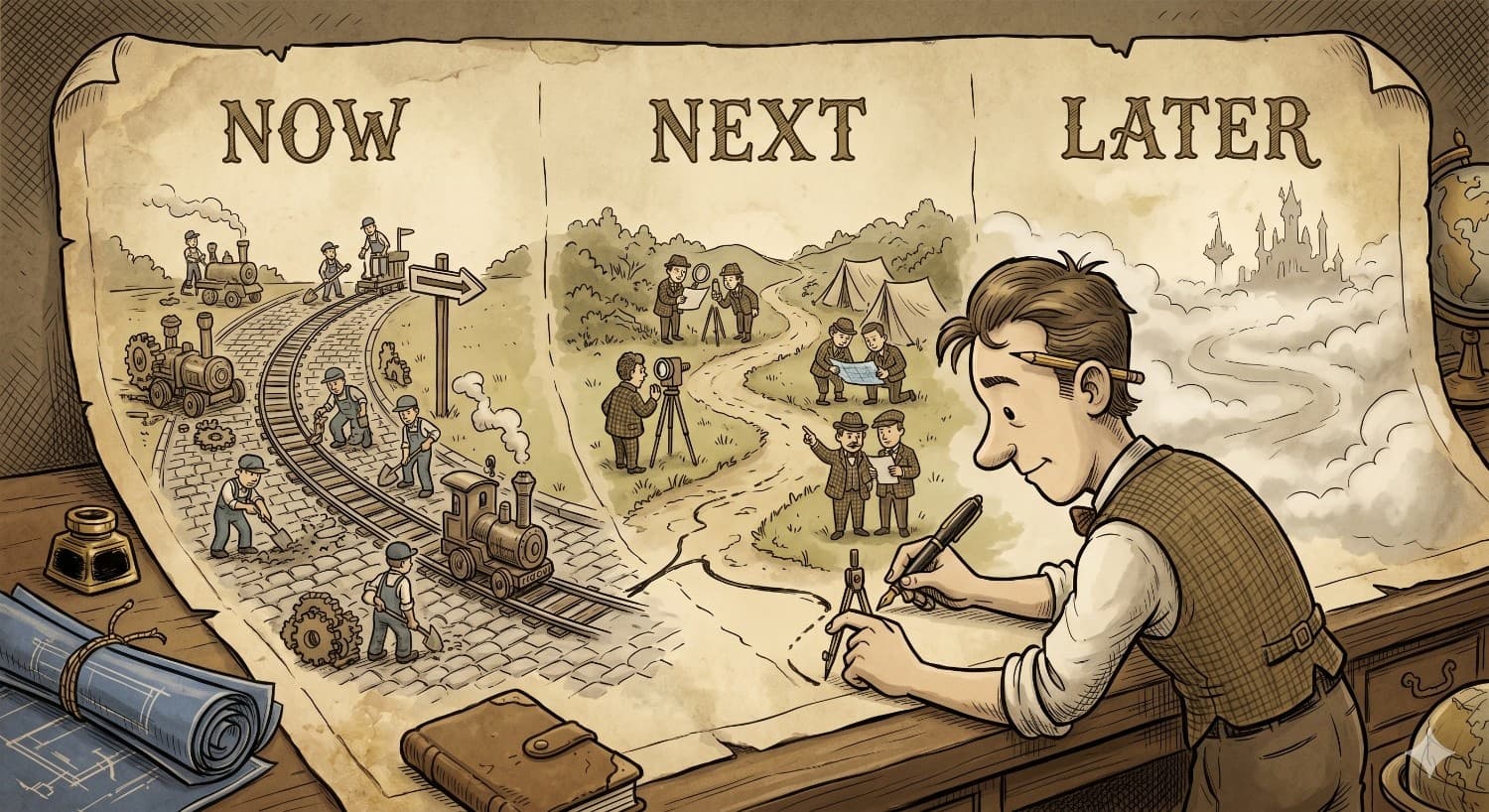
The annual planning cycle is a ritual that feels remarkably like a collective fever dream. Every year, product teams gather in windowless rooms to plot out a twelve month calendar. They draw long, confident bars across a Gantt chart, assigning specific features to specific weeks in October. They present these charts to executives, who nod with a sense of relief, believing that the future is finally under control.
This ritual is built on a foundation of false precision. It assumes that the market will remain static, that technical debt will not interfere, and that our first ideas are inevitably our best ones. In reality, most of those long term commitments will either be shipped late, shipped as broken versions of the original vision, or shipped on time only to find that the customer never actually wanted them.
   [ NOW ]      [ NEXT ]      [ LATER ]
    |---|        |---|         |---|
    | x | ---->  | ? | ---->   | O |
    |---|        |---|         |---|
   Action       Discovery      Vision
This is the Build Trap. As described by Melissa Perri in her work on effective product management, it is a state where a company becomes so obsessed with the quantity of features it ships that it loses sight of the value it creates. To escape this trap, we need a different way to communicate the future. We need a framework that respects the inherent uncertainty of building software while providing the clarity that a business needs to function. We need the Now, Next, Later roadmap.
The Failure of the Traditional Timeline
To understand why Now, Next, Later is so effective, we must first diagnose why the traditional timeline roadmap is so destructive. A timeline roadmap is essentially a list of solutions with dates attached. This structure creates three fundamental problems for any product organization.
First, it forces the team to commit to solutions before they have fully understood the problems. In Marty Cagan’s book Inspired, he highlights that at least half of our initial ideas simply will not work with customers. When we put a feature on a roadmap for Q3, we are telling the organization that we already know what the solution is. We skip the discovery phase and move straight to delivery. By the time we realize the idea is flawed, we are often too far down the line to change course without looking like a failure.
Second, timeline roadmaps ignore the reality of technical complexity. Software development is not a linear assembly line. It is a process of discovery. We often do not know the full extent of a technical challenge until we start writing code. When a roadmap is based on fixed dates, any technical surprise becomes a missed deadline, which erodes trust between the product team and the rest of the business.
Third, these roadmaps prioritize output over outcomes. Success is measured by whether the feature launched on a specific date, not by whether that feature actually improved user retention or increased revenue. This leads to a culture of checking boxes rather than solving problems.
The Core Philosophy of Now, Next, Later
The Now, Next, Later framework replaces the horizontal axis of time with three distinct horizons of certainty. It shifts the focus from "When will this be done?" to "What are we trying to achieve, and how sure are we about the path?"
   +-----------+   +-----------+   +-----------+
   |   NOW     |   |   NEXT    |   |   LATER   |
   +-----------+   +-----------+   +-----------+
   | High      |   | Medium    |   | Low       |
   | Certainty |   | Certainty |   | Certainty |
   +-----------+   +-----------+   +-----------+
The framework is organized into three buckets:
The Now bucket contains the initiatives the team is currently working on. These are well defined, validated, and in the process of being built or refined.
The Next bucket contains the initiatives that are up next in the queue. These are recognized as high priority problems, but the specific solutions are still being researched and prototyped.
The Later bucket contains the long term strategic direction. These are the big bets and the vision level goals that the team intends to tackle once the more immediate problems are solved.
By using these buckets, you are communicating a sequence of priorities rather than a fixed schedule. This gives the team the flexibility to pivot based on new data while giving stakeholders a clear picture of the strategic intent.
The Now Bucket: The Horizon of Certainty
The Now bucket is where execution happens. If an item is in this column, it means the team has already done the heavy lifting of discovery. They have talked to users, looked at the data, and validated that the solution is both viable and valuable.
In this phase, the goal is high quality delivery. Every item in the Now bucket should be tied to a specific, measurable outcome. Instead of a card that says "New Search Bar," the card should say "Improve search discoverability to reduce support tickets by ten percent."
This distinction is vital. By framing the Now bucket around outcomes, you are giving the engineering and design teams the autonomy to make the best tactical decisions. If they find a simpler way to reduce support tickets than building a completely new search bar, they are encouraged to do so. The goal is the result, not the feature.
From a data science perspective, the Now bucket is the space where we monitor our Key Performance Indicators (KPIs) with intensity. We use the principles of data literacy to ensure that our measurements are accurate. We are not just shipping code: we are running a live experiment. We monitor the launch, analyze the telemetry, and iterate quickly if the numbers are not moving in the right direction.
The Now bucket should be lean. A common mistake is to cram twenty things into this column. This leads to context switching and kills velocity. A focused team should generally have no more than two or three major initiatives in Now at any given time.
The Next Bucket: The Horizon of Discovery
The Next bucket is arguably the most important part of the roadmap, yet it is often the most neglected. This is where the product discovery work happens.
In a traditional roadmap, the Next items are just features waiting for their turn on the calendar. In the Now, Next, Later framework, the items in the Next bucket are hypotheses. We know there is a problem worth solving, but we are not yet committed to a specific solution.
      ?   ?   ?
       \  |  /
      [ DISCOVERY ]
       /  |  \
      * * *
This is the space where we apply the science of strategy. We treat our proposed initiatives as hypotheses to be tested. If we think that a new loyalty program will increase user Lifetime Value (LTV), we do not start by building the backend for a points system. We start by researching. We look for the kernel of the problem: why are users leaving? What is the specific challenge we are trying to overcome?
As designers, we use this horizon to explore user experience principles. We might use psychological design cues to make certain actions more prominent in our prototypes, testing if that actually drives the desired behavior. We build low fidelity mockups, conduct user interviews, and run experiments.
The goal of the Next bucket is to reach a decision to proceed or kill the idea. By the time an item is ready to move from Next to Now, we should have a high degree of confidence that it will work. If our research shows that the idea is a dud, we kill it right here. This saves the company from the massive cost of building a feature that fails in the market. This is how you escape the build trap: by being willing to say no to your own ideas before they reach the engineering team.
The Later Bucket: The Horizon of Strategy
The Later bucket is not a graveyard for ideas you are too polite to kill. It is a reflection of your product vision and long term strategy.
In Richard Rumelt’s Good Strategy Bad Strategy, he explains that a good strategy requires a guiding policy. The Later bucket is where that policy lives. It outlines the broad areas where the company intends to compete and win in the future.
Items in the Later bucket are naturally fuzzy. They are described in terms of strategic intent rather than specific features. You might see items like "Expand into the SMB market segment" or "Leverage machine learning for proactive risk assessment."
We do not have the data to define the solutions for these items yet. The market might change, or a new competitor might emerge before we even get to them. And that is exactly why they are in the Later bucket. We are signaling our direction without tying our hands.
The Later bucket is a powerful tool for alignment. It tells the sales team where the product is headed over the next year or two, allowing them to start strategic conversations with larger accounts. It tells the architecture team what kind of scalability they should be thinking about. It provides a sense of purpose and destination for the entire organization.
Managing Stakeholders Without the Comfort of Dates
The transition to a Now, Next, Later roadmap is often met with a specific kind of panic from stakeholders. Salespeople will ask how they are supposed to close deals without a delivery date. Marketing will ask how they can plan a launch campaign. Executives will ask how they can hold the team accountable.
   STAKEHOLDER VIBES:
   ( o_o)  "Where are the dates?"
   ( > <)  "I need a Q4 commitment!"
The answer lies in education. You must explain the cost of fixed dates. A fixed date on a roadmap is a promise made at the moment of maximum ignorance. The further away the date, the more ignorant we are. By giving a fixed date, we are essentially promising to stop learning.
Instead of dates, offer stakeholders certainty levels. Items in the Now bucket have high certainty and a narrow delivery window. Items in the Next bucket have medium certainty and a broader delivery window. Items in the Later bucket have low certainty and are purely directional.
When a stakeholder demands a date for a Later item, you must shift the conversation back to the Now and Next. Explain that the team is currently focused on the highest value work. If the Later item is truly more important than what is in Now, then a conversation about trade offs must happen. You cannot simply add more to the plate without taking something off.
This framework transforms the product manager from a feature waiter into a strategic partner. You are no longer just taking orders: you are managing the company’s investment in its own future.
The Role of Data in the NNL Framework
Data is the fuel that moves items through the roadmap. In a healthy product organization, you are not just guessing which items move from Later to Next. You are using a data driven approach to prioritize.
When an item is in the Later bucket, you are gathering broad data. This includes market trends, competitor analysis, and high level usage patterns. You are looking for signals that a particular problem is becoming more acute for your users.
When an item moves to the Next bucket, you shift to deep data. You run cohorts, look at specific drop off points in your funnels, and perform qualitative research. You are looking for the story the data is trying to tell you.
When an item moves to the Now bucket, you are using validation data. You define the success metrics upfront. You set up the tests. You ensure that your telemetry is in place so that you can see, in real time, if the feature is doing what you predicted it would do.
This rigorous use of data ensures that the roadmap is not just a list of opinions. It is a record of validated learning.
The Design Perspective: Designing for Outcomes
For designers, the Now, Next, Later framework is a liberation from the production line mentality. In many organizations, designers are constantly underwater because they are trying to stay one step ahead of the engineers. They are forced to produce final designs for features that have not even been properly defined.
In the NNL framework, the Next bucket provides the necessary buffer for high quality design. Designers can spend time in the problem space. They can conduct research to understand the user’s context. They can apply psychology based design principles to create solutions that are not just beautiful, but effective.
By the time a designer is working on a Now item, they are not guessing about the user flow. They have already tested it. They have already iterated on the wireframes. They are focused on the high fidelity details and the edge cases, knowing that the core value proposition has already been proven.
This leads to better products and a much happier design team. It moves design from a service to a strategic function.
   [ DESIGN CYCLE ]
    .---.    .---.
   ( Ask )->( Try )
    '---'    '---'
      ^        |
      '---(Learn)--'
Practical Steps to Transition Your Roadmap
If you are currently trapped in a world of Gantt charts and missed deadlines, here is how you can begin the transition to a Now, Next, Later framework.
First, do a roadmap audit. Take every item on your current timeline and ask: "How sure are we that this is the right solution?" If you have things scheduled for six months from now that have not even been researched, move them to the Later bucket immediately.
Second, reframe your items as problems to solve rather than features to build. Change "In-App Messaging" to "Reduce the time it takes for users to receive support." This shift in language is subtle but powerful. It opens up the solution space and focuses everyone on the outcome.
Third, establish your cadence of review. A Now, Next, Later roadmap is a living document. It should be reviewed with the leadership team at least once a month. This is not a meeting to approve the roadmap, but a meeting to align on the priorities. Discuss what was learned in the Next bucket and how that has changed the plan for the Now.
Fourth, be prepared for the date withdrawal. Your stakeholders will go through a period of discomfort. They will miss the false security of the Gantt chart. Stay firm. Point to the data. Show them the results of the discovery work. Once they see that the team is shipping higher value features more consistently, the demand for dates will naturally diminish.
The Psychology of the NNL Roadmap
There is a psychological component to why this framework works so well. Human beings are notoriously bad at estimating time over long periods. We suffer from the planning fallacy, a cognitive bias that causes us to underestimate the time and resources needed to complete a task.
By removing dates from the distant future, the NNL framework aligns our planning with the reality of our cognitive limitations. It allows us to focus our limited cognitive load on the immediate tasks while maintaining a healthy, high level awareness of the long term goals.
It also creates a culture of psychological safety. In a timeline driven culture, failure is public and punished. Missing a date is seen as a lack of competence. In an NNL culture, learning is the goal. If a hypothesis in the Next bucket is proven wrong, it is celebrated as a save, a moment where the company avoided wasting resources on a bad idea.
Why This is the Only Framework You Need to Start
The beauty of Now, Next, Later is its scalability. It works for a two person startup in a garage and it works for a multinational corporation with thousands of employees.
It works because it is based on the fundamental truths of product management:
- We cannot predict the future.
- Most of our ideas will fail.
- Our goal is to create value, not just ship features.
When you start with this framework, you are building your product culture on a foundation of honesty. You are admitting that you do not have all the answers, but you have a process for finding them. You are telling your team that you trust their ability to solve problems, and you are telling your stakeholders that you care more about their success than about hitting an arbitrary date on a calendar.
The Now, Next, Later roadmap is more than just a way to organize your work. It is a way to lead. It is a way to ensure that every hour of engineering and design time is spent on the things that matter most.
In a world that is moving faster than ever, the most successful companies will not be the ones with the best plans. They will be the ones that can learn and adapt the fastest. The Now, Next, Later roadmap is the engine of that adaptation. It is the framework that allows you to move with speed, focus, and purpose.
Common Pitfalls and How to Avoid Them
Even with a great framework, it is possible to drift back into old habits. Here are a few things to watch out for.
The Later Graveyard: Do not let your Later bucket become a place where ideas go to die. Regularly prune this list. If an idea has been in Later for a year and has not moved, it is probably not a strategic priority. Be brave enough to delete it.
The Now Bloat: As mentioned before, if everything is a priority, nothing is. Keep the Now bucket small and focused. If a stakeholder insists on adding something to Now, ask them which item they want to move back to Next.
The Next Skip: Some teams are tempted to move items straight from Later to Now because they feel really good about an idea. This is a trap. Every major initiative should spend time in the Next bucket for discovery and validation. Trust the process, even when you are excited.
Lack of Outcome Definitions: Every card on your roadmap must have a why. If you cannot define what success looks like in terms of user behavior or business impact, the item is not ready for the roadmap.
   ROADMAP CHECKLIST:
   [ ] Does it solve a problem?
   [ ] Is there a metric for it?
   [ ] Do we have capacity?
Final Thoughts on Product Mastery
Leveling up as a product manager means moving beyond the role of a task tracker. A true master of the field understands that their primary job is to manage uncertainty.
The Now, Next, Later roadmap is your most powerful tool in this endeavor. It provides a visual representation of your strategy, a focus for your team, and a clear communication channel for your stakeholders. It allows you to build a product that is coherent, valuable, and resilient.
Stop fighting against the reality of software development. Stop making promises you know you cannot keep. Embrace the buckets. Focus on the Now. Discover the Next. Dream of the Later.
This is the path to building products that customers truly love. It is the path to escaping the build trap and creating real, lasting value. It is the only framework you need to start your journey toward product excellence.
   ( ^_^)  Ready to build?
    / | \
     / \
As the industry shifts toward AI and more automated forms of decision making, the human element of product management becomes even more critical. AI can help us analyze the data in our Now bucket and suggest experiments for our Next bucket, but it cannot define the vision in our Later bucket. That requires human empathy, human intuition, and a human understanding of what makes a product truly great.
Use this framework to give your team the space they need to be human. Give them the space to think, to explore, and to create. That is how you build a product that stands the test of time. That is how you win.
Now, go and look at your roadmap. Is it a list of dates, or is it a record of your intent? If it’s the former, you know what you need to do. Start the transition today. Your future self, your team, and your customers will thank you.
Put It Into Practice
How would you handle it in the room?
Step into the simulator — test your PM instincts against real stakeholder pressure. No slides. No safety net.
Enter the Simulator