Beyond the Feature Factory: Mastering Product Management in the Age of AI
PM DEPOT
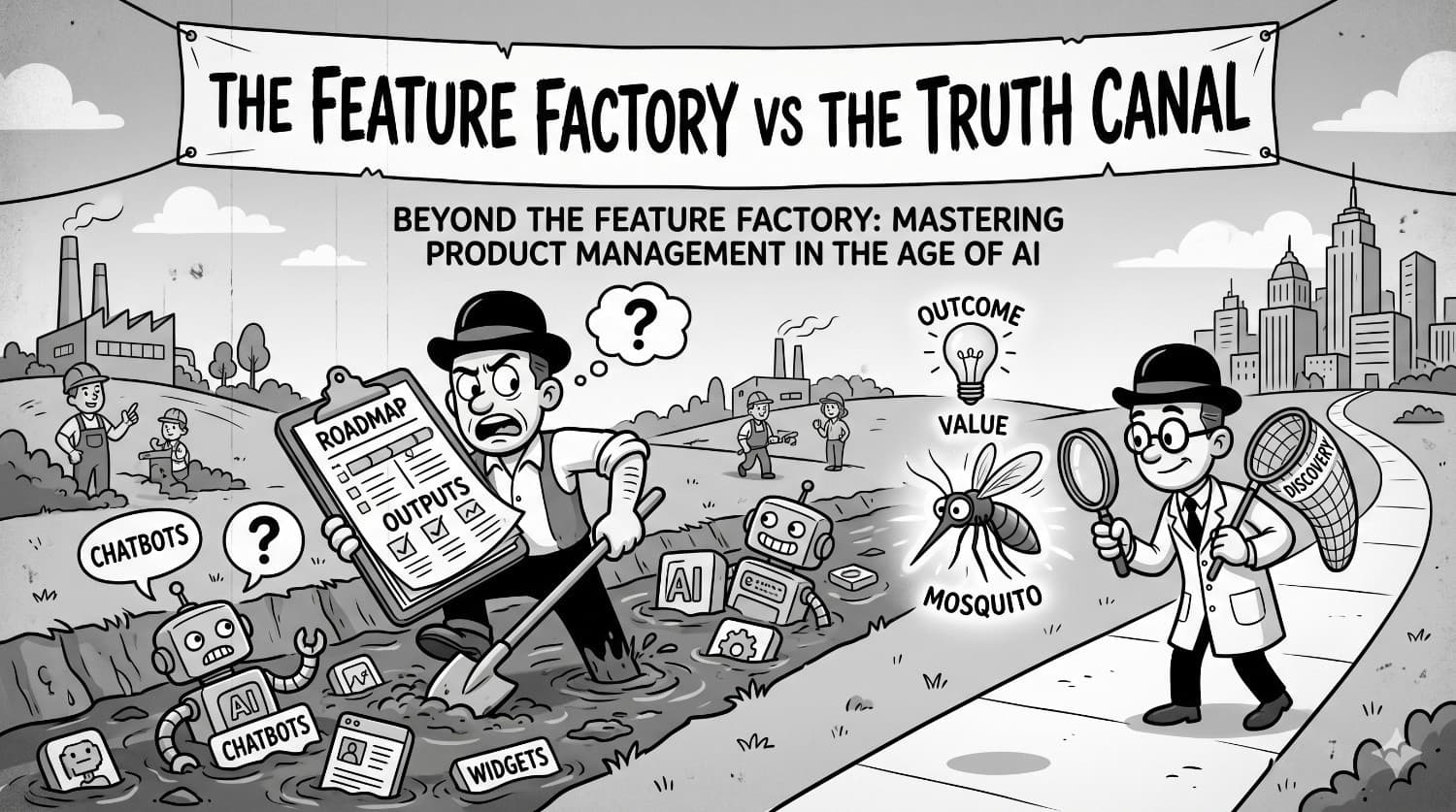
SEO Title: Beyond the Feature Factory: Mastering Product Management in the Age of AI Snippet Description: In 2026, shipping fast isn't a competitive advantage—it's the baseline. Discover why the "Great Canal Race" is the ultimate warning for modern PMs and how to pivot from output-obsessed delivery to outcome-driven mastery.
Real Talk: The Shipping Trap
Let’s be honest for a second. We’ve all had that sinking feeling on a Friday afternoon. You just pushed a major feature live. The engineering team is exhausted, the UI is pixel-perfect, and the "shipped" notification just hit the Slack channel. But deep down, you’re looking at the data and realizing... nobody cares. In the 2026 product landscape, being a "great builder" isn't enough anymore. We live in a world where AI can generate a production-ready codebase before you’ve finished your morning espresso. The "moat" of technical execution has evaporated. If your only value is moving tickets from "In Progress" to "Done," you aren't a Product Manager; you're a highly paid stenographer.
The real advantage now belongs to those who can learn the fastest. It’s about the shift from the output (the thing you built) to the outcome (the human problem you actually solved). To understand how we got here, we have to talk about a very expensive mistake involving a lot of dirt and a few too many mosquitoes.
The Panama Lesson: One Team Dug, One Team Discovered
In the 1880s, Ferdinand de Lesseps—the man who built the Suez Canal—decided to conquer Panama. He was the ultimate "Output Manager." He had the funding, the fame, and a rigid, non-negotiable plan: build a sea-level canal, exactly like the one in Egypt.
De Lesseps was obsessed with vanity metrics. He tracked cubic meters of earth moved and the number of steam shovels in the dirt. On paper, his progress reports were legendary. But he ignored a critical signal: his workers were dying of yellow fever and malaria by the thousands. He treated human lives as "operating costs" rather than a signal that his entire approach was flawed. He spent $287 million (roughly $9 billion today) and failed spectacularly.
Years later, the Americans took over. They didn't start by digging faster. They started by doing Discovery. They spent the first two years hunting mosquitoes and building sanitation infrastructure. They realized the "sea-level" output was a death trap because it didn't account for the volatility of the local rivers. They changed the entire architecture to a lock-and-lake system based on what the ground actually told them.
The takeaway: One team optimized for the spreadsheet; the other optimized for the truth. In 2026, if you’re still "just digging," you’re already underwater.
The ROI Trap: Stop Building for the Bin
We’ve all been in that meeting. You have a hunch—or better yet, some early user feedback—that a specific problem needs solving. But the "Stakeholder-in-Chief" stops you: "What’s the projected ROI on this experiment?"
This is a logical paradox that kills innovation. ROI assumes certainty. Experiments exist to destroy uncertainty. When you’re forced to project revenue for a feature before you’ve even validated if the problem exists, you aren’t being "data-driven." You are being "fiction-driven." This is how you fall into the Build Trap—a term coined by Melissa Perri to describe teams that measure success by volume rather than value. If you ship a beautiful feature that nobody uses, your ROI is always zero.
The Three Pillars of the 2026 Master PM
If you want to level up from a "Feature Manager" to a "Product Leader," your daily practice has to change. Here is how we're architecting the masters of the field:
1. Kill the Feature Roadmap
The traditional roadmap is a grocery list of solutions: "Add AI Chatbot," "Redesign Profile Page." These are traps. They rob your team of the autonomy to actually solve the problem.
Top-tier organizations now use Outcome-Based Roadmaps. Instead of "Add AI Chatbot," your goal is: "Reduce customer support response time by 40%." Suddenly, the team is empowered. Maybe a chatbot is the answer—or maybe, after looking at the data, you realize the "password reset" button is just broken. Solving the latter is cheaper, faster, and actually helps the human on the other side of the screen.
2. Speed to Evidence (StE)
Your most important metric isn't "Velocity" (how many story points you finished). It’s Speed to Evidence. * Assumption: "Our users want a social feed to talk to each other."
- The Old Way: Spend three months building a social feed. Release it. Watch it tank.
- The 2026 Way: Run a "Painted Door" test. Add a "Social" button to the menu today. If only 2% of people click it, you just saved three months of your life.
If your StE is measured in months, you’re de Lesseps. If it’s measured in days, you’re winning.
3. Financials as Guardrails, Not Goals
Money matters, obviously. But in the early stages of discovery, financials should be a filter: "Is this a problem worth solving?" Don’t let the CFO lead the discovery process. Use data science to identify the "Value Exchange"—that magic moment where a user receives enough benefit to change their behavior. Once you have empirical evidence of that exchange, then you bring in the spreadsheets to optimize the unit economics.
The Bottom Line
Mastering product management in 2026 requires something rare: the humility to admit what you don’t know and the scientific rigor to find the answer before you write a single line of code.
Don't be the team that just keeps digging the wrong canal because "it's on the roadmap." Be the team that has the guts to stop, look at the mosquitoes, and find a better way to move the world.
Are you digging, or are you discovering?
Put It Into Practice
How would you handle it in the room?
Step into the simulator — test your PM instincts against real stakeholder pressure. No slides. No safety net.
Enter the Simulator